Monday, March 26, 2007

Canon PowerShot SD430

Canon PowerShot SD430 Overview

Unlike other Canon PowerShot ELPH digicams, the SD430 "rocks." Stood on end like its cousins were designed to do, the Canon SD430 is actually resting on its slightly curved WiFi antenna. Following Nikon and Kodak into the WiFi-enabled digicam arena, the PowerShot SD430 offers a unique approach to shooting without cables, including its Wireless Print Adapter in the box for wireless printing to any PictBridge printer and offering wireless remote capture from your Windows computer. Canon built the SD430 with a 5.0-megapixel sensor and most of the basic features shared by its fellows in the SD lineup, but the big emphasis is on WiFi.

Canon SD430 User Report

DSCN9266.JPG
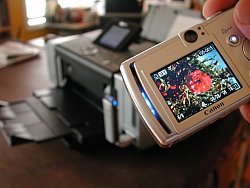
The SD430 & Print Adapter. Standing on end, yes, but rocking. The Adapter is plugged into a Canon iP6600D printer's PictBridge connector.

Thanks in part to FotoNation's PTP software, Canon, Kodak, and Nikon have all introduced WiFi digicams in the last year. Nikon, in fact, has expanded its use of WiFi to several new Coolpix models. The SD430 is Canon's first WiFi digicam, relying on Wireless B like the Kodak EasyShare-One. The feature adds about $100 to the price of a camera, so its no surprise none of these WiFi digicams are fully featured.

But WiFi on a digicam is not quite the same wonderful thing it is on a laptop or even a PDA. WiFi digicams talk only to proprietary software. Kodak's EasyShare One talks only to its EasyShare software or WiFi-equipped printers. Nikon's WiFi digicams talk only to its PictureProject software or printers equipped with its WiFi adapter. And similarly, Canon's SD430 only talks to its Windows ZoomBrowser software. It's a closed world.

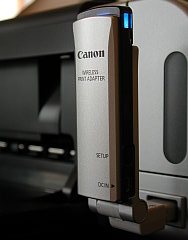
DSCN9260
The Print Adapter. Note the Setup button and the DC In port (neither of which were ever needed).

That has interesting ramifications. In Kodak's case, the EasyShare-One can communicate with Kodak's EasyShare Gallery, uploading and displaying albums or emailing images via the Gallery -- by far the most versatile choice. In Nikon's case, options are limited to transfering images to PictureProject either as you shoot them or after or printing them via its proprietary print adapter, all of which require configuration in the camera.


DSCN9261.JPG
Connected!
DSCN9262.JPG
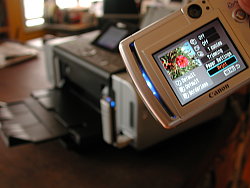
Print Options
DSCN9263.JPG
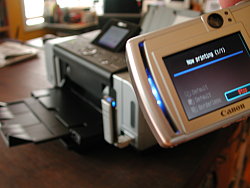
Printing ...
DSCN9264.JPG
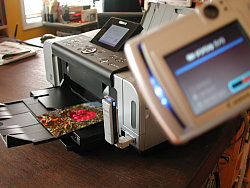
The Print
WiFi Printing. While the Canon SD430 can (for Windows users, at least) transfer images as you shoot and download images from the card, Canon has taken a slightly different approach, focusing on making prints. The included wireless print adapter has a USB plug to fits into a PictBridge socket on any printer. I tested it on several different brands of PictBridge printers (including Kodak's EasyShare printer dock plus series 3) and found I could make prints wirelessly and easily on all of them. PictBridge is PictBridge.

Unlike Nikon's WiFi digicams, the Canon SD430 requires no configuration to print. It's preconfigured to recognize the included print adapter. All I had to do was switch into Playback mode, press the Print/Share button, connect to the default Target Device (the preconfigured WA-1 adapter), select the PictBridge options and Print.

But the WiFi fun stops there for Mac users. Since there's no Macintosh version of the transfer software--a surprising omission--they're out of the game.


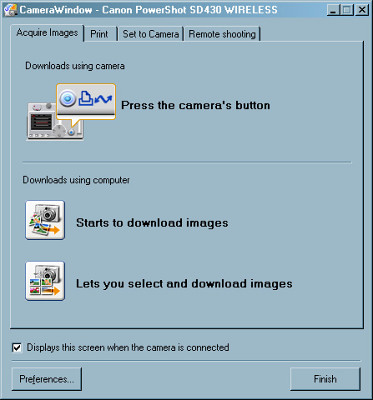
cw-setup.jpg

WiFi Setup. I fired up my Windows PC and popped in the software CD. It chugged away a while installing Canon's WiFi utility and a couple of other apps before I was ready to configure the camera for a wireless connection to the PC through our wireless router.

Like the Nikon, you have to connect the Canon SD430 via USB to the PC. The wireless utility pops up, prompting you to press the Menu button on the camera, find the WiFi setup screen and select the Register option. Then it's back to the computer to select whether you are connecting through a router or directly to a wireless card in the computer. Since I have a router, I had to enter the name of the router, the kind of security used and the password. All that was transferred to the camera for storage.

With the configuration stored in the Canon SD430, I turned it on in Playback mode and hit the Print/Share button. The Left and Right buttons let you select a Target Device. I had two: the print adapter and the router. It took about eight seconds to connect to the router, but it worked the first time, no problem.


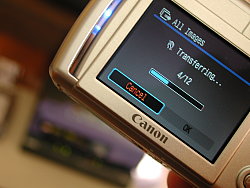
DSCN9252.JPG
A WiFi Transfer. We're sending 12 images through the router in the background to our Windows PC.
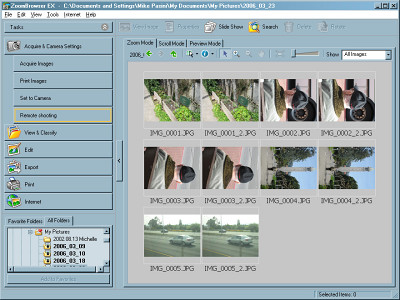
WiFi Transfer. Then all I had to do was press the Print/Share button to move my images through the router to the PC where ZoomBrowser EX had neatly stored my images in a folder of their own in the My Picture directory.

Finally, I disconnected by pressing the Menu button, going to the WiFi setup screen and selecting the Connect/Disconnect option on the Canon SD430. That shuts down the WiFi signal and saves battery life. WiFi can be very draining.

But I had one more trick to try. Remote capture.

zb-screen.jpg
Zoom Browser. We downloaded twice it was so much fun!

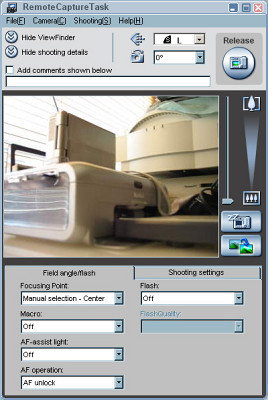
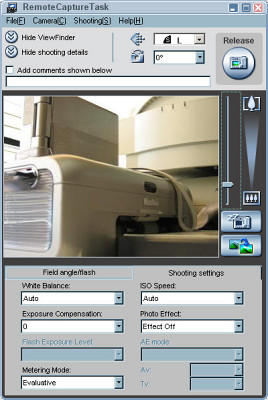
Remote Capture. This was pretty freaky, but you end up with a live view from the camera on your computer screen sent wirelessly from the camera.

It isn't obvious, but you click on the icon RemoteCaptureTask presents, which takes you to a window to select the target directory for your images. Finally you are presented with the remote shooting window, dominated by a live view of the scene the camera sees.

This is so cool it's refrigerated. You can even set some camera options like image size and compression and image orientation. You can add a comment to the image, too (if you're at the keyboard, you might as well use it). You can control the Canon SD430's zoom in real time (although it isn't quite as responsive as you may be used to). And you can change the focusing point and toggle Macro focusing, the AF-assist light, the Flash and the autofocus lock. On the Shooting settings tab, you can also change White Balance, Exposure Compensation, Flash Exposure Level, Metering mode, ISO, AE mode (well, not for the SD430), and Photo Effect.


rct-tab1.jpg rct-tab2.jpg
Remote Capture Zoomed In

The camera, meanwhile, shuts its LCD off, preserving battery power but also becoming a bit more discreet, although the blue WiFi indicator light is on. You blow your cover when you hit the Release button and the Canon SD430 makes it's default shutter sound (but you can disable that in the Setup menu, of course).

It takes about six seconds to transfer the image after you've shot it. Just about what it takes to move a file wirelessly during file transfers. You can also have the computer route that image to the printer for automatic prints.

Under the shooting menu, RemoteCaptureTask offers Interval shooting and Timer shooting, too.

Oddly enough, you can't quit the CameraWindow. You have to disconnect or turn off the Canon SD430 to exit the application.

Alternately, you can automatically transfer images wirelessly as you shoot them using the Auto Transfer function when in any shooting mode. Just visit the WiFi setup menu and set Auto Transfer on.

I called Canon's remote WiFi capture refrigerated not only because it's good but because it isn't an every day treat. For the most part, you'll use the SD430 like any other digicam--the old fashioned way.

Old Fashioned Fun. Even without a wireless connection, there's still a lot of plain old fashioned shooting fun in the Canon SD430. The digital ELPHs are a delight to use and the SD430 is no exception. It's just a pleasant experience, even if you use just one hand. You almost feel like you can twirl it around on your forefinger and slip it back in your holster.

For one thing, it's uncomplicated. There are only three modes: Still, Movie, and Playback. In Still mode, Auto handles most situations with ease. If you want to set the ISO, Metering mode, White Balance or dip into the Color Effects, the so-called "Manual" mode is the ticket. The Canon SD430 also features a selection of handy special shooting modes including Digital Macro, Portrait, Night Snapshot, My Colors and Kids&Pets.

These days, a two-inch LCD looks small but the consolation prize is an optical viewfinder, something not found on cameras offering 2.5-inch and larger LCD monitors.

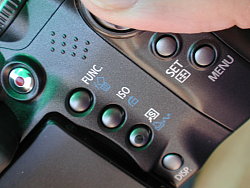
Controls are minimal, requiring almost no time to learn. The Print/Share button lights up in blue when activated (and the WiFi end of the camera blinks blue, too). A navigator ring (no buttons) also uses the Up arrow to set ISO, the Right arrow to select the Flash mode, the Bottom arrow to set Continuous or Self-Timer options, and the Left arrow to cycle through Focus modes, including Macro.

The Canon SD430 is ELPHishly fun to shoot with, effortless WiFi PictBridge printing, sure, but what about the pictures?

Image Quality. With the same lens, the Canon SD430 exhibits both the same slight corner softness and barrel distortion as the SD450. Images, fortunately, are not over saturated, with good color throughout. Automatic noise suppression only kicks in at slow shutter speeds of 1.3 second and above, so detail is preserved. And noise is really not apparent even at ISO 400 in a 4x6 print.

We have to wonder what's in the water at Canon headquarters to released the SD430 without Macintosh WiFi support, but even Macsters can enjoy the direct WiFi printing with the included adapter. And that's a lot more useful than just being able to transfer to a proprietary software package you probably wouldn't rely on anyway.

Recommendation. The Canon ELPH series of digital cameras continues to be a popular option for many consumers, given its tiny size and reputation for great quality. Although exposure control is mainly automatic, the availability of exposure times as long as 15 seconds and adjustable ISO increases the Canon PowerShot SD430's exposure versatility a great deal. The uncomplicated user interface and smooth styling help novices and more advanced amateurs alike feel at home, with enough control over the exposure to make both happy. And when it comes time to print, the Canon SD430 can do it effortlessly without a cable. It really is ridiculously simple. It makes a great all-around camera for anyone, and would make a good second camera for enthusiasts who don't want to lug along their full-size all-the-bells-and-whistles camera. All in all, it's one of the better subcompact digital cameras currently on the market.

Saturday, March 17, 2007

Canon PowerShot SD30 Digital

Introduction

Canon PowerShot SD30
Review Links
Overview
Picky
Details
Design
Operation
Recommended Accessories
Test Results
Specifications
Conclusion

Like its most recent predecessors, the Canon PowerShot SD30 Digital ELPH stands tall, replacing the SD20's fixed lens with a 2.4x zoom. Smaller if not thinner than many subcompacts, it uses a dock for USB transfers, to charge its Li-ion battery and for A/V output. Available in black, red, gold, or violet body colors, the 5.0-megapixel SD30 relies on a 1.8-inch LCD instead of an optical viewfinder for composing shots. Recording modes include the extremely unusual (and frankly, rather cool) "My Color" modes that allow you to selectively replace any color in your photo with a different one, or to make the image black and white with the exception of a single color. Overall, the PowerShot SD30 is one of the more appealing subcompact digicams we've seen. Read on for all the details!

Camera Overview

The new Canon PowerShot SD30 features the great looks and sharp design that are a signature of Canon's ELPH cameras. The "Perpetual Curve Design" of the SD30 has few flat surfaces or right-angled corners on the camera body -- consequently giving it a very smooth, comfortable feel in your hands. Very compact and quick on the draw (thanks to a smoothly operating retractable lens design), the Canon SD30 is a convenient point-and-shoot digital camera with a handful of extra exposure features for added flexibility, including a few features that you might not use every day, but that add some "wow" factor. With the lens retracted, the Canon SD30's front panel is smooth and pocket friendly, and its all-metal body is rugged and durable (although it will show scratches, so buy a soft case if this concerns you). Equipped with a 5.0-megapixel CCD, the Canon SD30 captures high quality images, suitable for making sharp prints as large as 8x10 inches with some cropping. Smaller image sizes are also available for email transmission or Web applications, and a movie mode captures video clips with sound.

The Canon SD30 features a 2.4x, 6.3-14.9mm zoom lens, equivalent to a 38-90mm zoom on a 35mm camera. Aperture is automatically controlled, but the maximum setting ranges from f/3.2 at full wide angle to f/5.4 at full telephoto. A maximum 4x digital zoom option increases the SD30's zoom capability to 10x, but keep in mind that digital zoom decreases the overall image quality, because it simply crops out and enlarges the center pixels of the CCD's image. Image details are thus likely to be softer when using digital zoom. Focus ranges from 1.0 feet (30 centimeters) to infinity in normal AF mode, and from 3.9 inches to 1.6 feet (10 to 50 centimeters) in Macro mode. The Canon SD30 employs a sophisticated, nine-point AiAF (Artificial Intelligence Autofocus) system to determine focus, which uses a broad active area in the center of the image to calculate the focal distance (a feature I've been impressed with on many ELPH models and have been happy to see continued). Through the Record menu, you can turn AiAF off, which defaults the autofocus area to the center of the frame. Also built-in to the PowerShot SD30 is an AF assist light -- a very bright orange LED -- which aids the focus mechanism in low light when it's enabled via a menu option. For composing images, the SD30 uses its 1.8-inch color LCD monitor. The LCD reports a fair amount of camera information, but excludes exposure information such as aperture and shutter speed.

Because the ELPH line is designed for ease of use, exposure control is automatic, increasing the line's appeal to point-and-shoot users. The Canon PowerShot SD30 follows this trend, including a series of unique Scene modes, but does provide a few exposure adjustments in its Manual mode. Main camera modes are controlled by a mode switch at the top of the camera's rear panel. Choices include Playback, Movie and Record. Still Recording mode includes Auto, Manual (similar to Program Auto), Macro, Portrait, Landscape, Night Snapshot, My Colors, and Scene (with choices being Kids & Pets, Indoor, Foliage, Snow, Beach, Fireworks, and Underwater). Shutter speeds range from 1/1,600 to 15 seconds (with the Long Shutter option on). With image review enabled, a small histogram is displayed along with the image to help evaluate exposure. Slow shutter speeds of 1.3 seconds or slower automatically invoke a Noise Reduction system to eliminate excess image noise in longer exposures. In straight Auto mode, the camera controls everything about the exposure except for file size, flash, etc. Manual mode on the PowerShot SD30 provides more hands-on control, with White Balance, Exposure Compensation, ISO, and some creative effects, but it isn't true manual control because the user is not allowed to set -- or even to know -- the aperture or shutter speed settings. Camera operation is straightforward, as you typically just point and shoot most of the time. Pressing the Shutter button halfway sets focus and exposure, and a focus confirmation target and beep let you know when the camera is ready to take the picture.

The special automatic and additional Scene modes on the PowerShot SD30 provide creative options and tweak exposure variables to accommodate common photographic situations. In Portrait mode, the camera opts for a large aperture to blur the background, making the subject stand out. Landscape optimizes camera settings for wide, expansive scenes. Night Snapshot mode uses the camera's flash and higher sensitivity if necessary to try to obtain an exposure with your subject and a dark background correctly exposed. My Colors provides nine creative options, including Positive Film, Lighter Skin Tone, Darker Skin Tone, Vivid Blue, Vivid Green, Vivid Red, Color Accent, Color Swap, and Custom Color. The Scene submenu includes even more options. Kids & Pets mode opts for a faster shutter speed to freeze quick motion. Indoor mode biases the white balance system toward tungsten or fluorescent lighting, attempts to reduce camera shake with wider apertures and higher sensitivity, and avoids using flash where possible. In Foliage mode, the Canon SD30's saturation is boosted to offer bold colors in foliage. Snow and Beach modes both bias exposure so that the camera is not fooled into underexposing images because of a bright background; Snow mode also adjusts white balance appropriately. Fireworks mode uses a long exposure to capture the trails of fireworks. Finally, Underwater mode -- designed for use with an optional underwater housing -- uses a white balance setting appropriate for correcting the cold tones of an underwater photo, and also tries to avoid using the camera's flash.

The nine options in the PowerShot SD30's "My Colors" mode, available for both still image and movie shooting, are worth a closer look. The Positive Film setting attempts to replicate the bold colors of positive film in the Red, Green, and Blue channels. The Lighter Skin Tone and Darker Skin Tone settings attempt to alter skin tones appropriately, without affecting the rest of the photo. The Vivid Blue, Vivid Green and Vivid Red options emphasize saturation in one channel only. Most unusual are the Color Accent and Color Swap features, however. In Color Accent mode, you place a small square in the center of the camera's LCD over a color you want to accent, and press the left arrow on the Four-way navigation controller. A narrow band of colors surrounding the color you selected will remain untouched in the final image; the rest of the photo will be in black and white. In Color Swap mode, you similarly select two colors with the square at the center of the LCD (one by pressing the left arrow; the other with the right arrow). The Canon SD30 will then replace one color with the other in your final image -- for example allowing you to make a green car appear blue. Both effects allow a little fine control over the color you selected using the left arrow key; you use the up and down arrows to slightly adjust the color you want to accent or swap. You can't, however, fine-tune the color you want to replace the swapped color with for Color Swap mode. Both the Color Accent and Color Swap modes are rather fun, and they're definitely very unusual, but the effects can be rather unpredictable. You generally end up with a slight fringe of the old color surrounding your replaced color in Color Swap mode, and it can be difficult to control the exact color you want to affect in both modes. For this reason, it is rather nice that Canon has provided the ability to set the SD30 through the Record menu to capture a duplicate copy of images captured in My Colors mode, without any color changes made. If you end up throwing away your color-altered image, you'll still have your original source image to change with an image editor, or just enjoy as a photograph. Finally, the Custom Color mode allows you to manually fine-tune the saturation of colors in the Red, Green, and Blue channels (plus the saturation of skin tones), with five steps of control over each.

The Canon PowerShot SD30 uses an Evaluative metering system by default, which means that the camera divides the image area into zones and evaluates both contrast and brightness among all the zones to determine the best overall exposure. A Spot metering option ties the exposure to the very center of the frame, and is useful for off-center or high contrast subjects, letting you pinpoint the exact area of the frame to base the exposure on. There's also a Center-Weighted metering option on the PowerShot SD30, which bases the exposure on a large area in the center of the frame. Exposure Compensation increases or decreases the overall exposure from -2 to +2 exposure equivalents (EV) in one-third step increments. A White Balance option offers Auto, Daylight, Cloudy, Tungsten, Fluorescent, Fluorescent H, and Custom (manual) settings. The Canon SD30 also offers a creative Photo Effects menu, which adjusts sharpening, color, and saturation. Sensitivity equivalents include 50, 100, 200, and 400 ISO settings, as well as an Auto setting. The SD30's built-in flash operates in Auto, Red-Eye Reduction, Forced On, Forced On with Red-Eye Reduction, Suppressed, and Slow-Synchro modes.

A two- or 10-second self-timer option counts down by flashing a small LED on the front of the Canon SD30 before firing the shutter, giving you time to duck around the camera and get into your own shots. In addition, a Custom timer function allows you to set the camera for a delay of 0-10, 15, 20, or 30 seconds, and a number of photos to be captured once the delay has been elapsed (from one to 10). After the timer expires, the camera will capture the number of photos requested with an interval of approximately one second between photos, and the flash does recharge quickly enough to capture 10 photos in a row with flash. This could be rather nice for people trying to take photos of a large family gathering. Thirty seconds gives you plenty of time to get into your photo, and with the ability to capture 10 images with one press of the shutter, there's a better chance you'll get a shot where nobody blinked or made a funny face. This is an innovative feature that brings the fun of the old photo booth into the digital era and makes it portable. As such, it should be renamed "Photo Booth Mode" to make it better understood by those most likely to use it. The tech-heads likely to find this mode are less likely to use it.

Stitch-Assist mode is the Canon SD30's panoramic shooting mode, which lets you shoot as many as 26 consecutive images. As each image is captured, a portion of it appears alongside a live preview of the current scene, helping you to line the next image up with a proper overlap. The series of images can then be "stitched" together into a single panoramic frame with the accompanying software. A Continuous Shooting mode captures a series of consecutive images (much like a motor drive on a traditional camera), at approximately one frame per second, for as long as the Shutter button is held down. The actual frame rate varies slightly with the resolution setting, and the maximum number of images will also depend on the amount of memory card space and file size.

The Canon SD30 also has three Movie Record modes, which record moving images with sound. Focus and optical zoom are fixed at the first frame, but you can use digital zoom while recording. Standard captures 640 x 480 images at 10 frames per second up to 1-GB. Compact captures 160 x 120 at 15 fps for emailing up to three minutes. My Colors captures 320 x 240 at 20 fps up to 1-GB. The PowerShot SD30's Playback mode allows editing movies longer than one second. You can save the new movie over the old one, or as a new file. During playback, you can also step through images frame by frame.

The My Camera settings menu lets you customize camera settings to a specific theme. Everything from the startup image to operating sounds can be assigned to a theme, either one of the pre-programmed themes or one downloaded from the camera software or stored on the memory card. The PowerShot SD30 also lets you record short sound clips in WAV format to accompany captured images, via the Sound Memo option, great for lively captions to vacation photos or party shots.

The Canon PowerShot SD30 stores images on SD memory cards (hence, the "SD" in its name). A 16MB card accompanies the camera, but I highly recommend picking up a larger capacity card, so you don't miss any shots. These days, a 128MB or 256MB card is a good tradeoff between cost and capacity. The camera utilizes a rechargeable lithium-ion battery pack for power, which accompanies the camera, along with the necessary battery charger. Because the Canon SD30 does not accommodate AA-type or any other off-the-shelf battery format, I strongly advise picking up an additional battery pack and keeping it freshly charged. The included dock functions as an AC adapter, charging the battery and powering the camera when downloading images. It's also where you connect the included USB cable or A/V cable connects the SD30 to a television set, for reviewing and composing images.

Also included with the Canon SD30 is a small wireless controller to control the camera when it is placed in the dock. Powered by a 3-volt lithium coin battery, the controller can manage playback on a television set when using the A/V cable, erase images, print when connected to a printer and download when connected to a computer via the USB cable.

A software CD accompanies the PowerShot SD30, providing any necessary drivers and editing software for both Windows and Macintosh platforms. The CD holds Canon's Digital Camera Solution Disk version 25.0 and also features ArcSoft's PhotoStudio. The Canon SD30 is Digital Print Order Format (DPOF) and PictBridge compatible, with detailed print settings in the Playback menu. Canon offers a selection of direct-connect printers as well, which simplifies printing even more. And Exif Print optimizes print settings when images are captured.

Recommendation

The Canon ELPH series of digicams continues to be a popular option for many consumers, given its tiny size and reputation for great build and image quality. Although exposure control is mainly automatic, the availability of exposure times as long as 15 seconds and adjustable ISO on the PowerShot SD30 increases the camera's exposure versatility a great deal. The uncomplicated user interface and smooth styling helps novices and more advanced amateurs alike feel at home, with enough control over the exposure to make both happy. The Canon SD30 makes a great "all around" camera for anyone, and would make a good "second camera" for enthusiasts for those times when they don't want to lug along their full-size all-the-bells-and-whistles camera. All considered, the PowerShot SD30 is one of the better subcompact digital cameras currently on the market.

Design
With gently flowing curves over most of the camera's body, the Canon PowerShot SD30's compact size is perfect for quickly stashing in a pocket or purse without worrying about damaging the rugged, all-metal body (though if you want to maintain that gorgeous finish, put it in a protective case first because it can get scratched). The retracting lens is a smart design that keeps the camera front completely flat when the camera is off, underscoring the camera's pocket-friendly design, while an automatic lens cover means you don't have to worry about smudging the lens or losing a lens cap. Measuring 3.78 x 1.78 x 0.94 inches (96.1 x 45.1 x 23.9 millimeters), the Canon SD30 should fit easily into the average shirt pocket. It weighs just 3.7 ounces (105 grams) without battery and memory card.
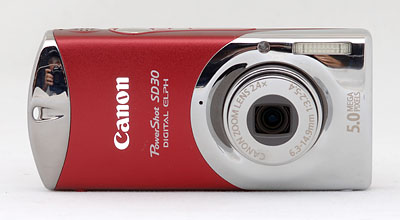
Several distinctive features on the front of the Canon SD30 identify it as an ELPH, with the lens off-center slightly toward the right, and the flash just above and to the right of it. A light emitter, directly above the lens, serves multiple purposes, including autofocus assist, red-eye reduction, and the self-timer countdown. The camera's telescoping lens moves into place quickly, projecting a little over half an inch from the front of the camera when powered on, and retracts fully within the camera when switched off to maintain a flat profile. (Startup time is a very fast 1.0 second.) The very small hole to the left of the PowerShot SD30's lens is the microphone. No real finger-grip is provided, so be sure to attach the accompanying wrist strap.
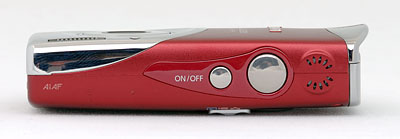
The Power button, Shutter button and speaker are located at the right of the PowerShot SD30's top and do not protrude noticeably.
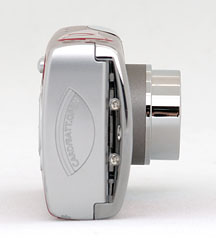
On the right side of the PowerShot SD30 (as viewed from the rear) is the battery compartment door protecting both the battery and the memory card slot. The door is a painted metallic plastic, and fits very snugly back into place with a gentle press -- unlike many such doors on digicams that seem impossible to ever get properly closed after they've first been opened. Inside the SD30's battery / memory card compartment, the battery and SD memory card slots line up side by side. A small spring-loaded latch ensures the battery won't accidentally fall out when you open the compartment cover. Adjacent to the door is the wrist strap attachment eyelet.
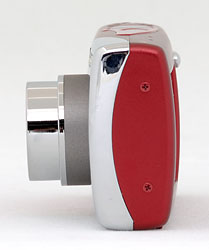
The opposite side of the PowerShot SD30 is basically bare, with only a couple of screws visible, but it lets the camera stand vertically on its end (although we wouldn't advise trying this on anything other than a perfectly level, smooth surface -- and even then not near an edge the camera could fall off). The text on the front of the camera and lens is actually oriented to be right-reading when the camera is stood on end.
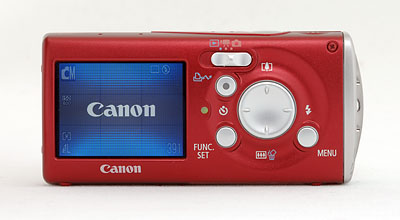
The remaining camera controls are on the SD30's rear panel, along with the LCD viewfinder. The 1.8-inch LCD monitor occupies the left side of the back panel with all the controls on the right. A three-position Mode switch at the very top of the camera's rear selects between Playback, Movie and Still mode. Below this is the Print / Share button, which features a blue LED in the center that lights when the camera is ready to print or transfer images, and blinks when either is in process. A Four-Way Arrow pad incorporates most of the quick settings, with the outside buttons handling navigation, Macro and Flash modes, and Zoom. The Function button is below and to the left of the Four-way Arrow pad, also serving as the Set button for making menu selections. Lower right of the PowerShot SD30's Four-Way Arrow pad is the Menu button.
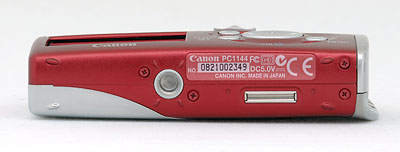
The Canon SD30 features a nice, flat bottom panel, which holds the metal tripod mount and the battery / memory card compartment. The tripod socket is off center to the camera body and the lens, not a great choice for panorama shooters since the mount is not below the center of the lens. But you can remove either the battery or memory card on a tripod-mounted SD30. Also on the bottom is the Camera Station Connector for the dock. The Connector provides AC power, USB connections and battery charging.

Camera Operation

The Canon PowerShot SD30's user interface is straightforward and relatively uncomplicated, with a similar menu setup and basic control philosophy as the rest of the current ELPH series. Frequently used camera's functions are controlled by buttons on the rear panel, with other settings controlled through the LCD-based Record menu. The Function/Set button provides access to the LCD menu's basic settings like image size, quality, and exposure compensation, which don't require you to sift through menu screens. The LCD menu system itself is quite efficient, as you view menu items organized in tabs instead of through a series of pages. Additionally, the Setup and My Camera menus are always available via the Menu button, regardless of the camera mode. With the instruction manual in-hand, it shouldn't take more than a half-an-hour to an hour to get comfortable with the camera.
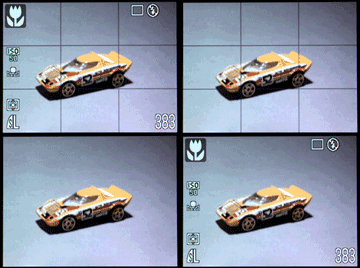
Record Mode Display: In any record mode, the PowerShot SD30's LCD display shows either the image area with a limited information display (On), or selected information (Off). The Info Display option in the Tools menu toggles the display on or off. When the information display is active, it reports resolution and image quality settings, the number of available images, Record mode, orientation, and a handful of exposure settings (although not aperture or shutter speed). But even when off, it displays some settings like the low battery warning.
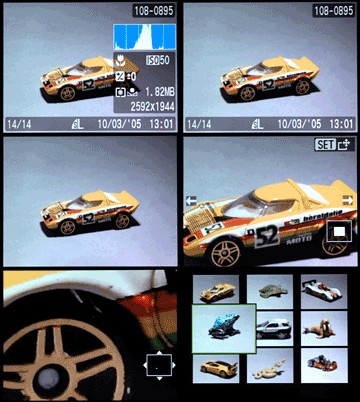
Playback Mode Display: The PowerShot SD30's Playback mode offers three options, including the image only (Off), the image with information (Standard), and the image with expanded information and a histogram (Detailed).


External Controls


Shutter Button
: Located on the top panel, this button sets focus and exposure when halfway pressed and fires the shutter when fully pressed. If the Self-Timer is activated, a full press of the Shutter button triggers the countdown.


Power Button: To the left of the PowerShot SD30's Shutter button on the camera's top panel, this button turns the camera on or off.


Mode Switch: At the top center of the rear panel, this switch controls the camera's operating mode, offering the following selections:

  • Playback Mode: Replays captured images and movies, with options for image management and printing.
  • Movie Mode: Captures moving images with sound in three different modes.
  • Still Mode: Sets the camera for still image capture with the various still modes available via the Function/Set button.
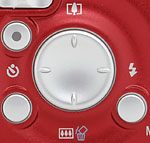

Four-Way Arrow Pad: This four-way rocker button is located to the right of the PowerShot SD30's LCD monitor and serves multiple functions. In any Settings menu, the arrow keys navigate through menu selections. In Record mode, the Left arrow selects between Single, Continuous and Self-Timer modes. The Right arrow selects the Flash mode, cycling through Automatic, Red-Eye Reduction, Forced On, Forced On with Red-Eye Reduction, Forced Off, and Slow-Sync settings. The Up arrow zooms in and the Bottom arrow zooms out.

In Playback mode, the Up arrow magnifies the image (pressing the Function/Set button subsequently enables scrolling around the enlarged image), and the Down arrow calls the Delete menu, while the right and left arrow keys scroll through captured images and movie files. When you zoom in on an image, all four arrows pan the view.


Function/Set Button: To the lower left of the four-way arrow pad, this control displays available options in any Record mode, and confirms selections once any menu has been invoked. In Playback mode, it activates Index Playback, in which up to nine images are displayed at once on the LCD. When used in Still Recording mode, the following options are available on the PowerShot SD30 (not all options being available in all modes):
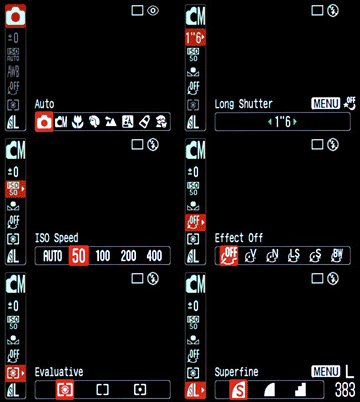
  • Shooting Mode: Selects among the available shooting modes: Auto, Manual, Macro, Portrait, Landscape, Night Snapshot, My Colors, and the Scene modes. In Movie Mode the options are Standard, Compact, and My Colors.
  • Exposure Compensation: Increases or decreases the exposure from -2 to +2 exposure equivalents (EV) in one-third-step increments.
  • ISO: Selects between Auto, 50, 100, 200 and 400 ISO equivalents.
  • White Balance: Controls the color balance of images. Options are Auto, Daylight, Cloudy, Tungsten, Fluorescent, Fluorescent H, and Custom (manual setting).
  • Photo Effect: Enables Vivid Color (high color saturation), Neutral Color (low color saturation), Low Sharpening, Sepia, or Black-and-White picture effects, or disables the effects altogether.
  • Metering: Sets the camera's metering mode to Evaluative, Center-Weighted, or Spot.
  • Resolution: Specifies the image resolution. Still image resolutions are 2,592 x 1,944; 2,048 x 1,536; 1,600 x 1,200; and 640 x 480 pixels; a Postcard mode also takes the resolution to 1600 x 1200 and locks the resolution to Fine; a date stamp can be printed on the image in this mode, and the top and bottom of the screen are greyed out when you half-press the shutter button, showing the portions of the image that won't fit on a 4x6 postcard. Pressing the Menu button allows you to select Compression settings of Superfine, Fine, or Normal. Movie resolutions are 640 x 480, and 320 x 240 pixels.


Menu Button: Lower right of the Four-way nav controls, this button accesses either the LCD menu system in both Record and Playback modes or options in the various Recording modes.


Print/Share Button: Located to the upper left of the SD30's Four-way nav, the Print/Share button is used for activating uploads to Windows computers or connections to a variety of compatible printers, including those complying to the PictBridge standard. The button glows blue when ready to print or transfer images, and flashes blue when printing or transferring images.

Camera Modes and Menus

Playback Mode: This mode allows you to scroll through captured images and movies, write-protect images, view a nine-image index display, zoom into a captured image, delete unwanted images, rotate images, set up images for printing on DPOF compatible devices, as well as play and edit movies on the Canon SD30.

Movie Mode: Records movie clips with sound in one of three modes. Focus and optical zoom are fixed at the first frame but digital zoom is available. Movie modes include Standard capture at 640 x 480 images at 10 frames per second up to 1-GB, Compact capture at 160 x 120 at 15 fps for emailing up to three minutes, and My Colors capture at 320 x 240 at 20 fps up to 1-GB.

Record Mode: Sets the PowerShot SD30 for still image capture. Pressing the Function/Set button lets you choose among Auto, Manual (similar to Program Auto), Macro, Portrait, Landscape, Night Snapshot, My Colors, and Scene (with choices being Kids & Pets, Indoor, Foliage, Snow, Beach, Fireworks, and Underwater).

Record Menu:
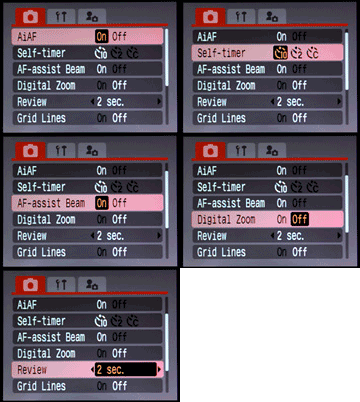
  • AiAF: Turns on the AiAF focus system. If switched off, the camera bases autofocus on the center of the frame.
  • Self-Timer: Sets the Self-Timer countdown to two or 10 seconds, or lets you specify a custom timer. The custom timer can have a delay of 0-10, 15, 20, or 30 seconds, and allows multiple shots (from one to ten in total) to be captured. If the camera is set to capture multiple shots, these are captured with an interval of about one second between shots, enough time for the flash to recharge if required. Focus and exposure are locked from the first shot. (A very handy feature for getting good shots of groups, as someone invariably blinks right as the shutter goes off.)
  • AF Assist Beam: Turns the AF assist light on or off. If on, the bright orange LED on the camera's front automatically illuminates in low lighting.
  • Digital Zoom: Enables the SD30's 4x digital zoom function, which is engaged by zooming past the optical zoom range. Also disables digital zoom.
  • Review: Turns the instant review function on or off, sets the amount of time that the captured image is displayed on the screen from two to 10 seconds, or allows a "Hold" mode where the image remains on the screen until the shutter button is half-pressed. The instant review function applies to still images only.
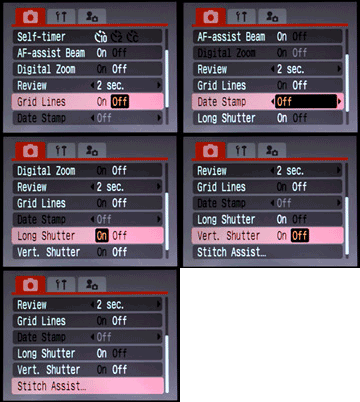
  • Save Original: Toggles whether the camera records an original unaltered image with any My Colors image.
  • Grid Lines: Enables or disables display of grid lines to help align shots or compose using the rule of thirds.
  • Date Stamp: Activates the Date Stamp feature, which imprints the date (and optionally, the time) on the lower right of images captured in "Postcard" mode only.
  • Long Shutter: Enables or disables longer shutter times. When enabled, the EV compensation option available when you press Function/Set button, will shift into Long Shutter mode when you press the Menu button. You can then select shutter speeds among 1.0, 1.3, 1.6, 2.0, 2.5, 3.2, 4.0, 5.0, 6.0 8.0, 10.0, 13.0, and 15.0 seconds.
  • Vertical Shutter: Allows the Function/Set button to release the shutter when the camera is held vertically.
  • Stitch Assist: Sets the shooting direction from left to right or right to left and starts the sequence, aligning shots until you press the Menu button to escape Stitch Assist mode.

Setup Menu:
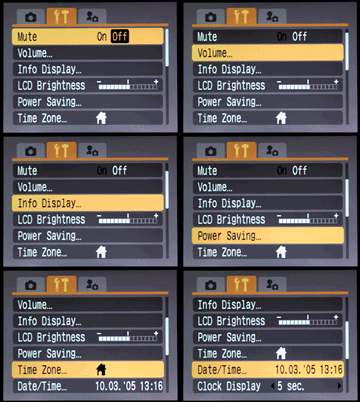
  • Mute: Turns the camera's beep sounds on and off, although warnings will still sound.
  • Volume: Individually sets Startup, Operation, Self Timer, Shutter, and Playback volumes. Five steps are available for each item, or the sound for each item can be disabled individually.
  • Info Display: Toggles displays modes on or off for Shooting Info and Review Info. For Replay Info, it selects between Detailed, Standard, or Off.
  • LCD Brightness: Adjust the brightness of the LCD backlight, with 15 steps of control available.
  • Power Saving: Toggles the camera's automatic shutoff function, which turns off the camera after a period of inactivity. Also sets display shutdown time to 10, 20, or 30 seconds, or to 1, 2, or 3 minutes.
  • Time Zone: Sets both a Home and World (away) time zone, so you can simply select one or the other to record date and time settings for that location. Setting a time zone displays a world map with scrollable time zones and major city names for each zone, making it easy to select a location.
  • Date/Time: Sets the camera's internal calendar and clock, as well as the format for dates (mm/dd/yy, dd/mm/yy, or yy/mm/dd).
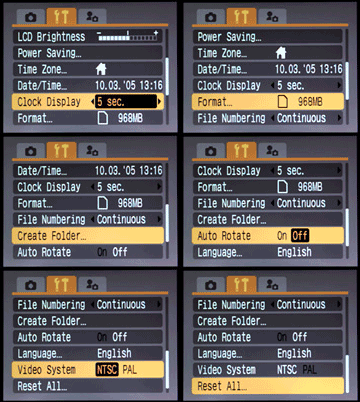
  • Clock Display: Controls the PowerShot SD30's clock display option, which shows the current time (but not the date) for a period of 0-10, 20 or 30 seconds or for 1, 2 or 3 minutes when the Function key is pressed and held for two seconds. (Handy if you forgot your wristwatch, I guess.) If set to zero, the clock is displayed only while the Function button is held in.
  • Format: Formats the Secure Digital card, erasing all files (even those marked for write-protection). An optional is available to low-level format the card.
  • File Numbering: Resets file numbering with each new Secure Digital card when set to Auto Reset. If set to Continuous, the camera continues numbering in sequence, regardless of memory card.
  • Create Folder: Immediately creates a new folder on the memory card to store images or creates the folder at the day and time you specify.
  • Auto Rotate: Toggles Auto Rotate feature on and off. The camera can detect when the camera is held approximately level, or when it is rotated left or right beyond approximately 45 degrees. If you aim the PowerShot SD30 vertically up or down, it will remember the orientation before you did so -- hence letting you control which orientation an image is tagged with even for shots where the camera is tilted enough vertically to prevent the sensor working.
  • Language: Sets the camera's menu language to one of a whopping 22 choices. English is the default setting.
  • Video System: Sets the camera's video-out signal to conform to NTSC or PAL timing.
  • Reset All: Resets all non-custom camera settings to their default values.

My Camera Menu
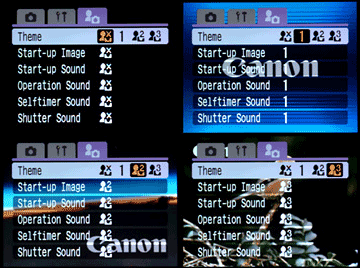
  • Theme: Selects a common theme for each My Camera menu settings item. Four options are available, the first one being Off. When a theme is selected, all of the following settings automatically adjust to that theme. Users can also select and upload their own sounds to the camera.
  • Start-Up Image: Sets the startup image when you turn on the PowerShot SD30 to: Black screen, Canon logo, Canon logo with sunset, and nature scene. You can also apply your own image using the Canon software.
  • Start-Up Sound: Sets the startup sound when you turn on the camera to: No sound, Musical tone (1), Musical tone (2), or Birds chirping.
  • Operation Sound: Sets the sound when any control or switch is used (except the Shutter button). Options include no sound, Beep, Musical tone, and Chirp.
  • Self-Timer Sound: Sets the sound that signals you when the shutter release is two seconds away. Options include no sound, Fast beeps, Telephone ring, and Howling.
  • Shutter Sound: Sets the shutter sound that you hear when you depress the Shutter button (there is no shutter sound in Movie mode). Options include no sound, Shutter sound, Musical Tone, and Bark.

Playback Menu System: Accessed by pressing the Menu button in Playback mode, the Playback menu also has subject tabs for the Setup and My Camera menus. Since these were described above, I won't repeat them here.

Playback Menu:
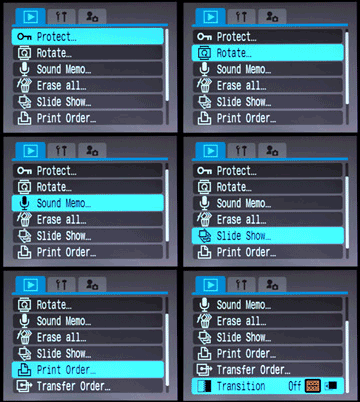
  • Protect: Marks the current image for write-protection, or removes write-protection. Protected images cannot be deleted or manipulated, except through card formatting, which erases all files.
  • Rotate: Rotates the current image. The first press gives a 90 degree clockwise rotation; the second press rotates the image 90 degrees counterclockwise from the original position. On the third press, the image returns to its original orientation. The image data is not actually rotated; the PowerShot SD30 actually sets a tag in the EXIF header, hence your software must recognize this tag to be able to recognize the orientation set in-camera.
  • Sound Memo: Records a short sound clip to accompany a captured image.
  • Erase All: Erases all files on the memory card, except protected ones.
  • Slide Show: Automatically plays all captured images in a slide show.
  • Print Order: Determines how many copies of the current image will be printed, with options for creating an index print, imprinting the date and time, and imprinting the file number.
  • Transfer Order: Select images for downloading to your computer.
  • Transition: Select a fade or wipe transition between images as they are displayed or disable the effect.

Print Connection: When you connect the Canon SD30 to a PictBridge, Canon Direct Print, or Bubble Jet Direct-compatible printer, a new menu is enabled, allowing easy print to a number of basic paper sizes, all without a computer. A special icon appears in the upper left hand corner, with the word SET right next to it, telling you that to adjust settings, you should press the Set button. You can select not only the size and type of paper, but you can also crop the pictures right in the camera. If you only print one size, full frame, you need only press the Print/Share button and printing of the current image begins immediately at whatever default settings were used last.
Thursday, March 8, 2007

Canon S3 IS

Canon S3 IS Introduction

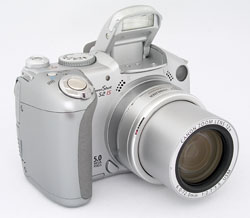
The Canon PowerShot S3 IS is the latest in an extremely popular line of long zoom cameras, following the 5.0-Mp S2 IS, the 3.2-Mp S1 IS, and the 2.6-Mp Pro90 IS.

The Canon S3 IS accommodates a wide range of users with its variable level of exposure control. Experienced shooters will appreciate the Manual, Aperture Priority, and Shutter Priority modes, while novices will find the Auto, Program AE, and Scene modes useful. With a full range of creative effects, the added attraction of 12x zoom Canon optics, and optical image stabilization -- a feature found on only a handful of digital cameras, most of them more expensive, the Canon S3 IS should appear high up on the lists for photographers looking for a long-zoom camera. Like its predecessor, the S3 IS's well-integrated Movie mode can record at 640x480 pixels and 30 fps with zoom -- and it records stereo sound.

The Canon S3 IS bumps resolution up to 6.0 megapixels (for 2,816 x 2,112 pixel images up from 2,592 x 1,944), increases the sensitivity range to ISO 800, features a slightly larger LCD (2.0 inches vs. 1.8), includes a Movie button available in any Record mode, and adds a 16:9 widescreen aspect ratio.

All in all, the Canon PowerShot S3 IS is quite a camera, with an amazing range of capabilities and good picture quality, all at an affordable price. Read on for all the details!

Canon S3 IS User Report

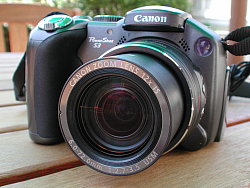
The S3 IS. The 12x zoom is fully extended beyond the two mics that capture stereo sound.

The digicam megapixel race of years past seems to have settled down now. Six megapixels seems to be the best tradeoff between detail and noise. Cramming more pixels on a small digicam sensor kicks up the noise, while companies seem to have decided that selling less than six megapixels is too tough a job. Maybe it's because digital SLRs are happy with six (although their sensors are much larger), but the crowd seems to be content with six in a digicam.

Subcompact digicams won a lot of hearts by featuring a large LCD. The larger the LCD the more detail you can appreciate on Playback. And if you're shooting a social gathering, that translates into more fun. An easy sell. The articulated LCD like the one on the Canon PowerShot S3 IS gives the photographer a better view of what the camera sees no matter how it's held, but it costs more to make, and isn't quite as glamorous--until you use one.

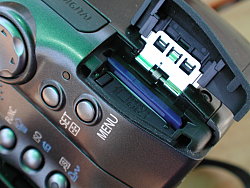
SD/MMC Card Slot. You'll want a few big SD cards to keep up with the S3 IS's Movie mode.

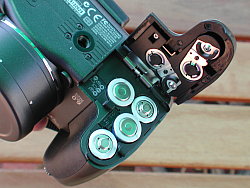
AA Batteries. We couldn't wear out a set of non-rechargeable lithiums in two weeks of use.

Then there's the zoom ratio. Cranking up the telephoto end of the zoom range is another sure winner. But to win, you have to do it in the optics, not with digital zoom. The word is out. Strangely, though, just as the news gets around, we're seeing some remarkably accomplished digital zooms. And sadly, many of the longer zooms don't bother with any kind of image stabilization.

When Canon designed the PowerShot S3 IS, they came down on the side of the photographer on all of these issues.

Its 6.0-megapixel sensor runs the sensitivity up to an ISO 800 equivalent that's not too noisy to make 4x6 prints; yet it retains excellent detail even in far shots taken with the digital zoom.

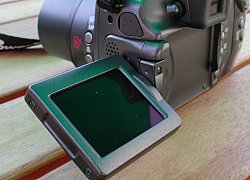
The Canon PowerShot S3 IS's LCD isn't large, but it is articulated. There are two kinds of people in this world. Those who've used articulated LCDs (and love them) and those who haven't. The design on the Canon S3 IS articulates 180 degrees out from the back, then twists 270 degrees on a horizontal axis, giving you the ability to see the screen from almost every angle imaginable.

And when it came to delivering a long zoom, Canon continued its impressive 12x zoom with image stabilization. This is the same lens the Canon PowerShot S3 IS has and it couldn't be improved. It's nice to see a large piece of glass now and then. Large LCDs are fun but a lens as small as a contact lens, as you see on smaller shooters, is a disappointment. Enthusiasts will live with a smaller LCD to get large glass. Glass is the magic.

Articulated LCD. It's a small LCD but it can dance. You can compose your image with the camera held overhead or down low, and even from the front and sides. As at least one photographer has put it, don't show me what the world looks like from 5'9" -- I already know.

The minute we got our hands on the Canon S3 IS, we wanted to start taking pictures. It's a photographer's dream.

Appearance. The Canon S3 IS looks nearly identical to the S2 IS, apart from its attractive gun-metal gray body color. Some functions have been assigned to different buttons, resolution and sensitivity have increased, the LCD is a tad larger, Sports mode has been added to the Mode dial, and a Wide Screen aspect ratio was tossed in for good measure. But the PowerShot S3 IS is an evolution, not a revolution.

Good thing, too.

The S3 IS simply demands to be held. It's too large for a coat pocket; but that fits, because this is a camera you want focused on the world, ready to go, not tucked in your pocket like an auto club card, there only for emergencies.

The PowerShot S3 IS is also an attractive design. I got a few compliments on it as I walked around town taking gallery shots. The body color, well-integrated components, and smart graphics just caught people's eye. I have a 25-year-old Mervyn's tie a friend gave me which never fails to prompt someone to comment how nice it looks. This never happens with our Jerry Garcia tie, so I know it isn't me. It's the tie. And the CanonS3 IS has the same effect. We were careful not to walk around with both it and the Mervyn's tie on at the same time. Might attract a crowd.

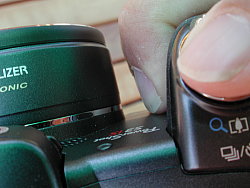
The Grip. Good thing I don't have long, red nails. You can angle your fingers downward, but it's a tight fit. I got used to it.

It's surprisingly compact from front to back (no, not thin). The right-hand grip protrudes just a bit less than the collapsed lens. And it isn't long, either, tucking almost all the controls within reach of your right hand and leaving the left side free for the LCD to swing out.

Nor is the Canon S3 IS heavy. You can slip it over your neck and forget about it. It won't swing away from you and bang into things; but it won't slide all over the car seat, either. It seems to have perfect balance.

Not a perfect grip, though. It's thin and a bit small even for my hands (which are not large enough to palm a basketball). When I grab the PowerShot S3 IS grip, my fingernails hit the body panel. Angling my fingers down alleviates that a bit, and certainly after using the camera a week, I wasn't as conscious of the cramped grip. But the minute I picked up a digital SLR with a more substantial grip, I felt a repressed relief worthy of half an hour on the Dr. Phil show.

The Lens Cap. Great idea -- a little fabric on the inside secures the cover to the lens.

The lens cap is worthy of a little comment, too. I tend to fumble lens caps, especially if they have strong springs. My fingers slip off the springs and the cap launches itself into the air like a frisbee; or worse, bangs off the lens. But the PowerShot S3 IS cap has no springs. Instead, it has a non-shedding fabric lining that snuggles securely against the lens housing barrel (not the lens itself). I actually enjoyed how it felt to slip the cap on and off. And it only once fell off accidentally, when I put the camera down on an uneven surface. Even better, when I forgot to take it off (you can't quite see the front of the camera when operating it), the lens harmlessly nudged it away when protruding into its shooting position. A small touch--perhaps even a compromise--but another example of this camera's design sophistication.

Display. Fortunately, we were distracted by the view. We set the diopter adjustment for the electronic viewfinder on the S3 IS (an unavoidable choice on any long zoom) and quickly went through the options on the Display button (off, minimal information display and complete information). I prefer the more verbose information screen.

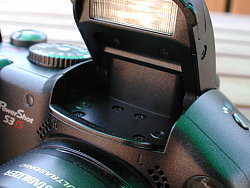
Count the Screws. This thing is built. We counted six screws just in the flash assembly.

But while hunting around for how to turn on the grid (which makes rule-of-thirds composition, not to mention straight horizons, easier), I discovered the Custom Display menu item, with which I could tailor the minimal and verbose info displays on both the LCD and EVF. I could include the histogram on all of them or not, for example. Just mark the checkbox. Very fine indeed.

The resolution of both displays is fine enough that the small live histogram can be appreciated at a glance. It's also fine enough that grid lines don't obscure the scene. They're helpful without calling attention to themselves. Canon struck a fine balance with those display features.

The 2.0-inch articulated LCD is larger than the 1.8-inch version on the Canon S3 IS, adequate but a bit of a letdown after playing with LCDs no smaller than 2.5 inches. Still, because it's articulated, I'll take it.

You don't have to be a paparazzo to appreciate an articulated LCD (hey, that should be a t-shirt; or a Steely Dan song). I've chatted with many Coolpix owners (myself included) who bemoan their aging swivel digicams for their two or three megapixel sensors, but won't part with them because they can angle the LCD toward themselves regardless of the angle the lens takes on the scene. Canon has kept this concept alive with its articulated LCDs, and they get outright prolonged applause for including one on the Canon PowerShot S3 IS.

The mechanism on the Canon S3 IS seemed a little stiff to me. Stiff enough that I often lost my grip and worried about scratching the LCD. I didn't, but I sure didn't like losing my grip.

Performance. The Canon S3 IS doesn't keep you waiting: Not when you start it up (even though the lens has to extend); not when you've taken a shot; not when you're shooting in Continuous mode; and not when you're shutting down.

It isn't instant, like a digital SLR, but I never felt like I had to wait for it. And not having to wait meant I felt free to turn it on or off at will. When it takes a camera a long time to start up or shut down, I just let the power management routine put it to sleep so a half-press of the shutter button wakes the camera up. With cameras that have extendable lenses, this is a risky strategy. But the PowerShot S3 IS was quick enough to shut down and start up, and the lens extends and retracts quietly.

I didn't always zoom the lens all the way out to 12x (or even further with its acceptable digital zoom), but I did always leave the image stabilization on. That's because image stabilization isn't only useful at telephoto focal lengths.

‘It's a photographer's dream.’

Sure, bring even a 10x zoom without image stabilization at full telephoto up to your eye and you'll think you have an incurable disease. The subject will jump around in the electronic viewfinder so badly that you'll think it's a moving target. That makes image stabilization desirable, if not essential, for a long zoom at telephoto.

But take that same non-stabilized camera indoors and you'll need flash even at wide angle. With stabilization like we see on the Canon S3 IS, you can shoot hand held at about two stops slower than without it. So you can shoot without flash -- and red-eye.

Hand Held
Shutter Speeds

1/15

1/13

1/40

Take a look at the gallery to see a few normally impossible shots in Program mode:

  • A high school graduation announcement shot at ISO 80 and 1/15 second. That's the lowest noise possible (to preserve the paper texture) and an impossible hand held shutter speed. The aperture was wide open at f/2.7, hence the shallow depth of field.
  • The Rumbolino's stick shift knob against the blurred background of the dash at 1/13 second and f/2.7. You can bet I didn't cram a tripod into the passenger seat to get that shot. (Editor's Note: Rumbolino is apparently the name Mr. Pasini has for his Alfa Romeo.)
  • Even Lucien Labaudt's fresco murals at Beach Chalet profited from image stabilization at 1/40 second. If you like to shoot in museums (a terrific source of free art for your walls), a camera with image stabilization will let you get a better shot than one without it. You can't use flash or a tripod in most museums that permit photography, but you won't need either with image stabilization.

I like having ISO 800 available and appreciate Canon's decision to let us pick a more aggressive Auto ISO (Auto High) for the S3 IS than the standard. I shot the mandolin strings that appear in the gallery at ISO 800 and the noise, although evident when examined closely, didn't bother me enough to tap into one or another noise reduction filter.

In short, I really appreciated the versatility that the PowerShot S3 IS's increased sensitivity and optical stabilization provided.

Shooting Experience. As camera bodies go, the Canon PowerShot S3 IS is really quite small (though its name is not small at all). One hand can handle it with your thumb doing almost all the work on the controls and your index finger working the zoom and shutter.

Controls. They're all within reach of your thumb. No EV button, no OK button, no dials, but once you learn how to access EV, confirm selections and adjust sliders, it makes sense.

I'm not a big fan of Canon's menu system or its button layout. I'm not a big fan of elevator Close and Open buttons either (and always get them embarrassingly wrong). They aren't intuitive and, unless you train yourself, you forget them both easily.

But functionally, Canon's control system works well on the PowerShot S3 IS. There's no EV button, for example, but one press of the Menu button brings up the shooting menu with EV selected. You just have to press the Left or Right arrow to set EV. That's functionally equivalent to pressing an EV button and spinning a dial. It's just that until you find that out, you're at lose ends.

Similarly, I'm not thrilled with the Canon S3 IS's Set button sitting below the four-way controller. I prefer an OK button in the middle of the controller -- and really like a joystick there instead of an OK button. No hunting around. No time-motion studies required. But, again, the Set button functions efficiently if you remember when to use it.

Despite its high quality and stereo sound, I wasn't nearly as enamored of the Canon S3 IS's Movie mode as I felt I should be. The problem was the size of the files. A 19-second stereo clip took 37.3MB of disk space. The S3 IS saved the 640x480-pixel, 30-fps movie as an AVI, not the most compact form.

I wasn't charmed by the separate Movie button either. You don't have to switch to Movie mode, you can just hit the Movie record button in any Record mode and the PowerShot S3 IS will start recording a movie. Conversely, you can hit the Shutter button while capturing video and the S3 will blank the movie frame, record a shutter sound and save a JPEG of the scene you were looking at when you pressed the Shutter button before continuing filming. That little effect can't be disabled, either.

Summary. I don't want to mislead anyone with all the enthusiastic comments that have preceded this conclusion. Much as I enjoy shooting with the Canon PowerShot S3 IS, I think I'd better keep it here a few more weeks to, uh, refine my impressions. You can't rush through a fine camera any more than you can gulp down a fine wine. You have to savor them both. Slowly. With a smile on your lips.

Canon PowerShot S2

Canon PowerShot S2 IS Digital Camera

Camera QuickLook
Review Date
06/28/05
User Level
Novice to Experienced
Product Uses
Family / Travel / Special Events
Digicam Design
Point-and-Shoot or Manual control
Picture Quality
Very Good, 5.0-megapixel CCD
Print Sizes
11 x 17 or 8 x 10 with some cropping
Availability
May, 2005
Suggested Retail Price
(At introduction)
$499

Introduction

Review Links
Overview
Picky
Details
Design
Operation
Recommended Accessories
Test Images
Specifications
Conclusion
Article: Digital SLR or All-in-one Digicam?
By Shawn Barnett

With the price of digital SLRs finally within reach, should you stick with the All-in-one digicam or move up to an SLR? Why buy a high-end digicam when digital SLRs are so close in price? Do digicams still have a purpose? What are the pros and cons? An avid photographer, I spent some time thinking about that myself. Come see what I discovered about digital SLRs versus all-in-one digicams.

The Canon PowerShot S2 IS is the sequel to an extremely popular long zoom camera, the 3.2 megapixel S1 IS. The 5.0 megapixel Canon S2 IS and its predecessor follow in the footsteps of a well-received model from four years past, the 2.6-megapixel PowerShot Pro90 IS.

The Canon S2 IS accommodates a wide range of users with its variable level of exposure control. Experienced shooters will appreciate the Manual, Aperture Priority, and Shutter Priority modes, while novices will find the Auto, Program AE, and Scene modes useful. With a full range of creative effects, the added attraction of 12x zoom Canon optics, and optical image stabilization - a feature found on only a handful of digital cameras, most of them more expensive, the Canon S2 IS will feature prominently on the shopping lists of photographers looking for a long-zoom camera. A big part of the story of the Canon S2 IS though, has to do with its movie capability: Not only can it record at 640x480 pixels and 30 frames/second, but you can use the zoom lens while recording movies (a surprising rarity), and it records stereo sound. All in all, the Canon S2 IS is quite a package, with an amazing range of capabilities and good picture quality, all at an affordable price. Read on for all the details!

User Report
By Shawn Barnett

The S1 IS (the Canon S2 IS's predecessor) is easily one of the most popular 3.2 megapixel cameras still on the market. Indeed, as of this writing in June 2005, the S1 IS is still number 9 in the Top Ten Sellers with our readers, among the Dave's Picks cameras. Maybe it's the camera's handsome, burly looks; or perhaps the low price for such a long, image-stabilized zoom. There's no question that the S1 IS hit a sweet spot in the market, but it had a few shortcomings.

Canon's PowerShot S2 IS overcomes most of those shortcomings and increases the camera's utility as a digital still/video hybrid. Of the two main (only?) complaints with the S1 IS, the first is not really all that valid: Folks wooed by high pixel counts were put off by the S1's 3.2 million pixels, and scads emailed to ask whether it was okay to get one anyway. I told most that it was absolutely okay, with one cautionary note -- Which brings me to the S1's second major problem: image noise at ISO 400. Our tests showed the ISO 400 results to be pretty good, even in low light; but out in the field, I personally found the color to be unacceptably blotchy at ISO 400, and recommended that people stick to ISO 200 or lower. It's not a problem unique to the S1 IS; what is unique is that both of these nice little image-stabilized cameras will get you accustomed to shooting in low light precisely because of their image stabilization, and you'll develop a tendency to push your exposure too often.

The Canon S2's 5 megapixel sensor handles both the perceived and the literal shortcoming with ease. While it still has noise at high ISO (like all point and shooters), it is far better controlled, appearing more even than that of the S1, and its higher megapixel sensor allows for plenty of cropping after capture.

Body
The Canon PowerShot S2 IS features a body design similar to that of the S1, with slightly more aggressive contours and accents throughout. It shares a familiar look and feel to the rest of the PowerShot line, along with many of the same exposure options and features. With dimensions of 4.4 x 3.1 x 3.0 inches (113 x 78 x 77.5 millimeters) and weighing some 18.55 ounces (526 grams) with batteries and SD memory card, the Canon S2 IS only a little heavier and just a smidge fatter our front due to the larger lens. This isn't a camera you'll slip into a shirt pocket, to be sure - it might fit larger coat pockets, but most likely you'll wear the camera around your neck on the included neck-strap, as I've seen so many proud S1 owners do.

We were also pleased to note that the grip on the Canon S2 IS is much better than that on the Canon Digital Rebel XT, a larger SLR camera. It's the only major criticism we had of the XT, and here the smaller, less expensive PowerShot S2 IS turns out to be a better camera ergonomically regardless of family member. It is sized just right, with your two middle fingers wrapping comfortably around the grip, the pinkie curling around underneath, and the index finger resting comfortably on the shutter. Your experience will vary, but even Dave (who was positively incensed by the XT's grip) liked the grip on the S2 IS, finding it easy to hold and balance the entire camera.

The rest of the camera body is smooth and fits the hand nicely. All controls work as expected, and the design is easy and comfortable. My only complaint is the odd power toggle/off button combination. While I understand the design, I still find myself turning it in the wrong direction. To access Record mode, whose icon is on the top left of the toggle, you have to put your thumb on the back of the toggle and move it to the right (which moves the indicator on the front of the toggle to the left). It's unnecessarily complex, and I'm not sure why they didn't just put an on/off button and a Record/Playback button to switch between the two modes.

Lens
The main reason to look at the Canon PowerShot S2 IS is the big lens. This really is the kind of lens we all want on our cameras. Just pull the zoom ring to the right, and you're able to get right up on whatever you want. Years ago, people were disappointed when they got their 200mm SLR zoom lenses because that didn't amount to such a high magnification; and they were even more disappointed when they found out how much the 300 and 400mm lenses cost. The Canon S2 IS will take you out to the equivalent of a 432mm lens, and that's not counting the digital zoom (something we don't encourage users to consider; you'll be happier cropping after the fact). Still, if you need to make your friends cry, you can tell them that your 4x digital zoom gives you the reach of a 1,728mm zoom (if not the clarity).

Image Stabilization
As if that almost ludicrous sounding focal length weren't enough, the Canon S2 IS will help you get a solid shot even at the longest zoom settings. A computer-controlled lens element inside the lens is actually moved around in time with most detected camera movement. Like most such systems, it's calibrated to adjust for twitches, breathing, heartbeat, wind; all the things we don't think about that affect our ability to hold a camera still. While we don't think about it, our cameras are honest storytellers, and will usually report these minute movements to the image sensor, which will in turn deliver blurry images to our memory cards. Even if you're a rock solid person with nerves of steel, you're going to get at least some motion blur at either the longest focal lengths or the lowest shutter speeds (like indoors in low light). Image stabilization means you'll get more clear shots more of the time.

If you shoot in Continuous mode with the Canon S2 IS, you'll be able to see the image start to float as soon as you tease the shutter button. It's the best way to shoot in low light, because it tells you how well you're holding the camera. You'll soon work with the camera better when you learn to wait for the image to stabilize. As I mentioned earlier, getting used to such a system is both good and bad, so you do have to carefully review your results. Switch to Playback mode and use the zoom lever to check for motion blur if you already know you're pushing it. If you're getting blur, you might need to raise the ISO, brace the camera against something, or flip up the flash. The IS system is excellent, and will help you get great shots you'd have never gotten otherwise, but you'll be even happier if you check how well it's doing. (Also note that the S2 IS has several different IS modes. Faced with a really challenging situation, you'll probably find that the "Shoot Only" IS mode will be more successful at compensating for extreme shake.)

Another area image stabilization comes in handy is in video capture. Usually a feature of high-end video cameras, the Canon S2 IS's always-present video mode is also enhanced by the camera's image stabilization, lending a more professional look.

AF
The S2 IS has seen an improvement in AF speed and sensitivity, due to its DIGIC II chip. This chip has been improving Canon's entire line over the last year, making all manner of functions faster and more efficient. One feature I'm missing though is the 9-point AF found on other cameras like the Canon S70, and the popular A95. In its place is the AF system borrowed from the Canon G6, called FlexiZone AF. This system allows the photographer to move the AF point all around the screen so focus can be set to wherever you deem important. In portraits, for example, you'd want to move the AF point to keep the eyes of your subject in focus. As much as I like that, in fast action settings, I've preferred the 9-point AF system, for its surprisingly accurate and speedy processing of image data. Its decisions have impressed more than they've disappointed, and I think the typical S2 IS user would be better served.

There's a manual focus mode as well, accessible by pressing the Manual Focus button on the side of the lens. I suppose it's a good feature to have, but I've never found it that useful. Even with the magnified view and distance scale, you have a heck of a time seeing any change as you adjust the focus. I find the AF system reliable enough that I've never had occasion to use manual focus. Still, it's there if you need it.

LCD
The S2 IS is really a combination of much of Canon's best PowerShot technology, and among the high points is the 1.8 inch flip out and swivel LCD. You really don't know you need this until you start to use it. Shots you'd have never considered are suddenly possible. Overhead, down low, even pictures of yourself can be framed with unprecedented accuracy and comfort. If you like to try new angles on a subject, you need a camera with a versatile LCD like this. Because LCDs generally wash out in sunlight, Canon wisely included an EVF (electronic viewfinder), to which you can switch for easier, more familiar image framing. It's a shame you can't have an optical viewfinder, but this compromise is necessary with such a long zoom.

Exposure
As seems to be the case with more and more all-purpose Canon digicams, the S2 IS has the full complement of manual and automatic exposure choices. If you just want to get the shot, you can set the camera to Auto (green zone) or P (program) and just point and shoot. But if the lighting is challenging a quick turn either left or right puts you in greater control. In Shutter, Aperture, and Manual modes, you can control how much depth of field or how much you want to freeze or blur action. But in the Scene modes, you still wield control, because you're telling the camera just what situation you're facing; and it will make the decisions from there. Settings like Portrait and Fireworks are great examples of the camera handling very unique and specific settings for you. By far, my favorite mode is Night Portrait. I've found this mode useful both in night scenes and indoor scenes, softening the impact of the flash on a subject by dialing it back, and leaving the shutter open a little longer to capture the true ambient light of the room or night backdrop. The result is a better picture that tells a truer story of the setting I saw and wanted to capture.

Long movies in stereo
The Canon PowerShot S2 IS has an unusually capable movie mode for a relatively inexpensive digicam, and its capabilities have been extended over the S1. Its movie mode allows you to capture up to 1GB of moving images and sound at either 15 or 30 frames per second, with available resolutions of 640 x 480 or 320 x 240 pixels. (Note though, that while a gigabyte of movie sounds like a lot, its only about 9 minutes worth of action at the highest quality and frame rate setting on the S2 IS.) A high-speed memory card is necessary if you want to record at the larger image size and/or higher frame rate. Its unique stereo microphones appear above the lens to the left and right, and do seem to create some separation, especially when the subjects are nearby; however, to experience the stereo, you'll need to transfer the video files to a device that can play stereo, or else play the video through a TV through the included stereo A/V cable. Several sound options allow you to change the recording bit rate and reduce wind noise on recordings. (This last is a nifty feature that's been carried over from Canon's camcorder line. - As far as I know, this is the first time that it's appeared on a digicam.)

Zoom and snap during movie recording
The Canon S2 IS's movie mode is also unusual in that it allows the zoom lens to operate while recording movies with sound. In almost all cases, digital cameras that record movies with sound disable the zoom mechanism during movie recording, as the noise of the zoom motor tends to interfere with the audio track of the movie. With the S2 IS though, Canon has chosen to allow zoom operation during movie recording, but at a reduced speed of actuation. The result is moderately successful. In quiet surroundings, you can still clearly hear the noise of the zoom motor, but it's not terribly intrusive, while in noisier environments, the noise should be entirely masked by the ambient sound. This is a useful compromise, but I do think that the manual should include a caution about zoom motor noise to make users aware of the potential impact on their sound tracks. Autofocus operation is relatively silent, thanks to the Ultrasonic focusing motor built into the S2 IS.

New to the Canon S2 is the ability to capture images during video recording. Because you activate video from the red and silver button on the camera's back, the main shutter button remains available to focus and snap a picture. And these on-the-fly still shots aren't 640 x 480 images, but full 5 megapixel images. The video stream is interrupted for a bit under a second for this capture, which creates a gap, but Canon was clever about dealing with this. In video Playback they've allowed the gap, then inserted a shutter sound and added just under a second of the still image that is captured. The resulting video looks very like the stereotypical movie scene where the private investigator is training his lens on his unsuspecting subject and snapping shot after shot. The shutter sound is inserted whether you have the sound on or not, and it cannot be disabled. I think Canon is doing that purposefully so the source of the gaps is always understood. If the AF light is turned on, you see not only the camera's focus action, but the beam itself. Personally, I'm not sure why you'd want to take a picture while doing video, but if you want to you can with the S2 IS.

Playing with the Canon S2 IS makes it clear that its designers were having a good time making not only a versatile camera, but a camera that would be fun as well. In addition to the color effects that were available on the S1, the S2 has added a Custom Color setting. You can perform all kinds of tricks with this, including intensifying or dimming specific colors, or even completely replacing one color with another. The example given in the manual shows how you can sample a color from one car and see what your own car might look like in that other color. It's really only effective if the two objects are distinct and evenly lit, but can nonetheless be fun to create surreal effects right in the camera. You can also easily darken or lighten skin tones, and emulate slide film, giving your pictures that lovely saturated "Kodachrome(tm)" look.

Memory
Add at least $70 for a nice-sized memory card to your budget before purchasing the S2 IS, because the camera only comes with a 16MB SD card. If you plan on taking advantage of the video mode, get a high speed card (Lexar 32x or above or SanDisk Ultra or Extreme) of at least 512MB, if not a full 1GB. If you have no plans to use video, then still invest in a large SD card or two. The camera captures images that are about 2MB in size apiece. You'll enjoy the camera enough that you'll fill a smaller card pretty quickly.

Battery
When I first used the camera I burned through the batteries, but it turns out I had a few sets of bum AA's. Loaded with a set of new high-quality NiMH AA rechargeables, I've been getting very good battery life, and Dave and Luke's direct tests of power drain show very good battery life indeed. The camera comes with a set of four AA alkalines, but go stick those in a flashlight and get a good set of rechargeables. Click here to read the "battery shootout" page to see which batteries currently on the market are best, or here for the review of the Maha C-204W charger, Dave's current favorite.

An AC adapter is available for the camera, which plugs into the right side of the camera, so if you're doing a lot of studio or video work, you might want to invest in one of these. A couple of sets of high-capacity rechargeable NiMH batteries and a good-quality charger really eliminate the need for the adapter in all but the most extreme cases though.

Overall, the Canon S2 IS is an impressive camera that is bound to be very popular. Its speed improvements are welcome, and its utility as a digital video/still hybrid is enhanced with the larger lens, higher resolution, and AF assist lamp. Photo enthusiasts will likely be torn between the S2 IS and the Canon G6, and family buyers will wonder whether to invest in an A95 or the S2 IS. Enthusiasts might want to augment their G6 with the S2 given its longer-ratio zoom and familiar controls, but family cam buyers looking at a 5 megapixel A-series should absolutely give the Canon S2 IS a serious look. For just a little more money and with a slightly larger body, they'll get an image stabilized 12x zoom with a virtually silent Ultrasonic focusing motor, and a camera that does double duty as a still and video camera. When it comes to viewing your images and videos at the end of the day, it's a quick upload of both types of content via the fast USB 2.0 connection from the S2 IS to the home computer, making it more likely that the content will actually be viewed in the first place. Compared to carrying separate digital still and digital video cameras, carrying the Canon S2 IS is both lighter in the bag, and easier on the pocketbook. I expect to see a lot of these little silver cameras around a lot of necks this year, this one is a real winner.

The Imaging Resource What"s New