Nikon D200 Overview
The Nikon D200 was announced in November 2005, almost three and a half years after its predecessor, the D100. While it occupies the same place in their lineup though, between the high-end pro cameras (the D2Xs) and their consumer line (currently topped by the D70, although rumors and a teaser on Nikon's own site suggest that the D80 is right around the corner), the D200 really goes far beyond what would normally be considered as a prosumer model. In virtually every detail, the Nikon D200 creates a new category, that of a compact professional SLR. (For a detailed comparison between the D200 and other current dSLR models, see the Nikon D200 comparison matrix on another page of this review.)
In our testing and evaluation of it, the Nikon D200 consistently impressed us with its ruggedness (including full environmental seals, a first on a camera selling for less than $4,000), excellent user interface, exceptional feature set, and sure-footed performance. We begin below with a User Report written by senior editor Shawn Barnett, but be sure to check out all the other pages and sub-pages of this review for the full story on its performance and many features.
Nikon D200 User Report
by Shawn Barnett
Nikon's return to competitive form is complete. The Nikon D200 joins the D50, D70s, and D2x to take up second position in the ranks of the company's most formidable SLR bodies, marking the fourth home run they've hit in the last two years. With only one qualifier, I can say that the D200 is worthy of both the praise and the price, and is a body that owners of Nikon glass have truly needed.
Once again, the Nikon D200 is what I'll call a "'tweener" camera, in that its feature set falls neatly between its major competitor's camera line. While the Nikon D50 is excellent, its resolution, features, and price fall below that of the Canon Rebel XT. The D70's features, and price likewise fall just below the Canon 20D. And the new Nikon D200 exceeds the Canon 20D in resolution, price, and features. Between the 10.98 megapixel D200 and the 12.4 megapixel D2x is the 12.8megapixel Canon 5D. Though you could argue which was "better" for what usage, in terms of price and the majority of features, the 5D sits above the D200 in most aspects due to its full-size sensor and most certainly its price, and the D2x rests above the 5D in price and suitability to a wider range of professional photography tasks. I won't belabor the point further; the fact is that neither company makes a camera that can be neatly compared with another in the line.
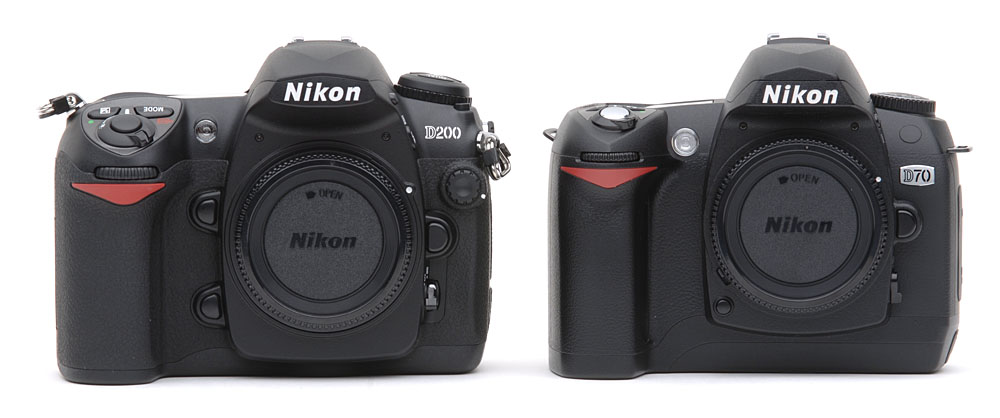
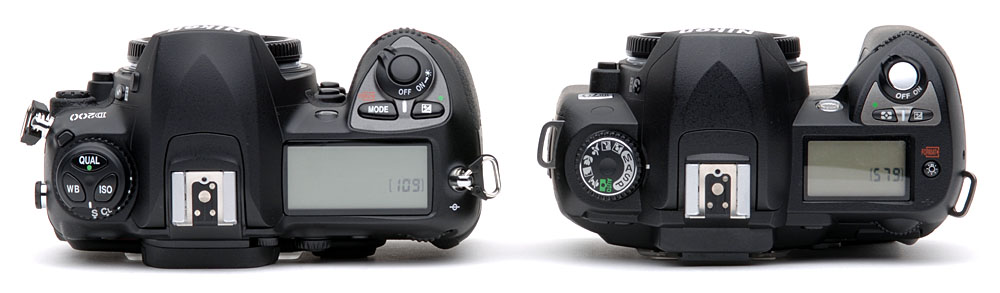
| D200 vs D70 |
 |
 |
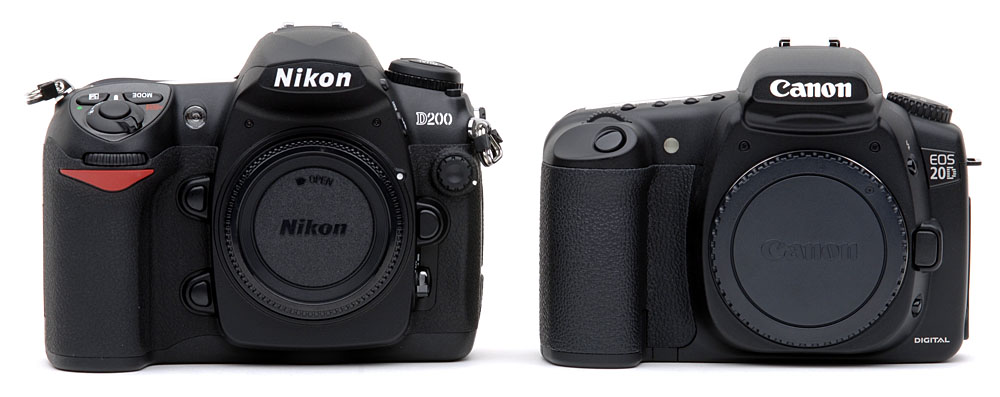
| D200 vs EOS-20D |
 |
|
I have no trouble picking the two major cameras to compare the Nikon D200 with, however. Most who will be interested in the D200 will want to know how it compares to the Canon 20D and the Nikon D70/D70s. Those thinking of a 5D or D2x should also look hard at the D200 though, because it will meet most serious photographer's needs at less than half the price of either. The Nikon D200 is more like these latter two in terms of price, weight, and design, most notably because there are no full auto modes for the novice to fall back on, and no scene modes. In practical terms, all this really means is that the photographer must set the ISO manually as the lighting changes, pop up the flash if necessary, and make a habit of checking the histogram to verify exposure.
 Aside from the first few test shots of my desk to verify that the D200 was working, I didn't actually look at the images or evaluate the camera until I could set up my lights and set someone down for a portrait session. It just felt like that kind of camera. I was right. Both I and the D200 were in our element. I'm not a portrait photographer by trade, but I enjoy it as a hobby. And I love nothing more than taking pictures of people. A good photographer can make great shots with any camera, but a camera like the Nikon D200 makes it effortless.
This was just a short session, but the D200 was like an apprentice, capturing images and showing them to me with flourish, eager to have me tune and try again. Once the lights were all set, the camera settings tweaked to perfection, and the model warmed up, the great shots just kept coming. AF was fast and responsive, in both the 11-point wide area and single-point modes, a good bit more reliable and speedy than the D70. Its AF was about on par with the Canon 20D, only pausing unexpectedly once or twice out of about 80 shots.
Though I do my best to shoot with every camera we get, I tend to shoot Canons when I have an important job, as that's the product line I have the most experience with. But there are enough truly excellent features to the Nikon D200 that I would have few reservations about using or buying one.
Many qualities are important in a camera, but one quality cannot be merely talked about, it has to be experienced: the shutter sound. When I press the D200's shutter release, I am reminded of some of the excellent film cameras I've used in the past. It's softer at both the start and finish than those of many current d-SLRs. Even though the Nikon D200 delivers the same five-frame-per second speed, it does so with less apparent vibration and a softer snap than the 20D. The D70 is soft, too, but makes more noise for a longer period than either of the entry-level pro models. The D200 feels more like the un-motorized film cameras of old, with no whining sound during or after release. It has manners.
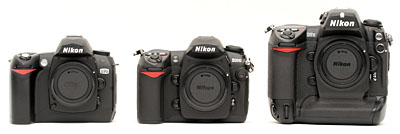 |
Three siblings: As you can see, the D200 is much closer to the D70's size than it is to the D2x's |
Like the 20D, the Nikon D200 is solid as a rock and about as heavy. In my experience, a camera with some substance helps me take steadier shots, so I like cameras with some heft. Both cameras have a magnesium alloy body, with the D200 weighing about 145 grams more than the 20D (body only; about 5 ounces). The D200 is also bigger than both the 20D and D70, albeit not by very much. The extra weight is offset by a well-balanced body and a superb grip.
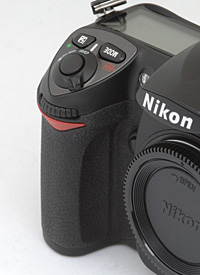
I love Nikon's recessed inner grip area that gives the balls of your fingers someplace to sink into for a better hold. For portrait shooting, I would definitely buy a battery grip for the D200. Hanging three pounds of combined camera and lens from your fingertips for a few hours on a shoot gets tiring regardless how deep the grip's divot. A vertical grip adds weight, but also doubles battery life while providing a hold that is more compatible with human anatomy. Unlike the D70s, the D200 and 20D accept a factory-built vertical grip/battery pack.

With your hand wrapped around the grip and your finger on the shutter, the depth-of-field preview button is perfectly placed for your middle finger to stop that lens down in a hurry. It's the best placement I've seen in years. My only complaint is that on both Nikons closing the aperture is almost as loud as firing the shutter, while it's comparatively whisper quiet on the 20D
Controls
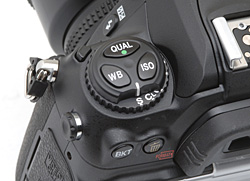 Of all the Nikons I've shot recently, I prefer the D200's control layout. Having more important items in plain view--meaning on the top deck and back of the camera--makes a more complex camera like this easier to manage. On the D2x, the ISO, Quality, and White Balance buttons are on the back, way below the LCD, a most un-intuitive location that frequently left me hunting for these vital controls. Now they're perched prominently atop the drive mode dial left of the pentaprism, a much better location. With your right hand on the grip, it's very easy to press one of these buttons and turn the Main Command dial while looking at the gorgeous expanse of monochrome status LCD on the top right deck. This status LCD is even bigger than the D2x's top LCD. Though I prefer mode dials when there are more than a handful of exposure modes, the D200's four modes are better handled by pressing the Mode button and turning the Main Command dial.
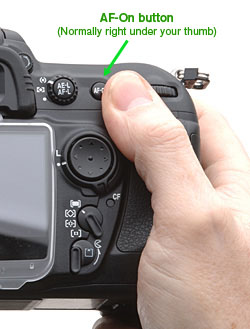 Because I'm one to lock a camera to the central AF point for its greater precision, the AF-ON button that rests right under your thumb is particularly appealing. I just pick the point I want in focus, press and hold this button to focus, then recompose and press the shutter button to set exposure and fire.
I also like that most important pro features are available via a dial or button rather than a menu item, more like the Konica Minolta 7D that bristles with such controls. Mirror lockup mode, for example, is on the Drive Mode dial rather than buried in a Custom Function, as it is on the 20D.
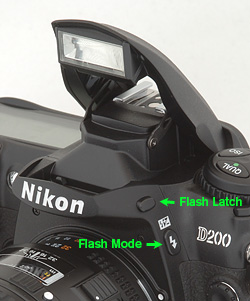 The built in flash controls offer the best of both worlds, with a manual pop-up release and an adjacent button that you use in conjunction with the Main Command dial to change the settings. Both the D70 and 20D use a motorized release because their full auto modes need to be able to activate the pop up flash when necessary. With this single pop-up flash and a single SB-800 or SB-600 external flash, you open up the world of Nikon's Wireless Lighting System, where you can control dozens of flashes to light a given scene in a remarkable myriad of configurations. Though the full system works best with an SB-800 mounted on the camera as the main control--offering to control three groups of flashes plus the SB-800 itself--the D200's onboard flash will control up to two groups in addition to the onboard flash, a significant upgrade in capabilities from the D70s. (For more information on the Nikon Wireless Lighting System see our video describing how we used it at PMA 2005.)
Viewfinder
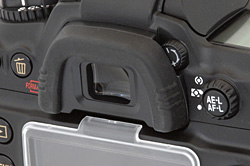 Long overlooked by nearly all digital SLR manufacturers is the very small optical viewfinder offered by most current cameras. It's mostly due to the smaller APS-C sized imager used in most cameras, but Nikon has answered the call, making the D200's viewfinder slightly magnified. It's tough to measure, but holding both a D70 and D200 vertically and up to each eye, you not only look silly, but you get two images you can overlay visually to compare relative magnification. I'd say that the D200's viewfinder appears about 20% bigger than the usual APS-C viewfinder. Though there is still some vignetting of the view when I have my glasses on, I can still see corner to corner, and the status display is more visible than on the 20D, where I have to choose between seeing the entire frame or the status display. On a camera whose only viewfinder is optical, having a bigger one can only be better, and this one appears to be even bigger than the one on the D2x.
Other nice features of the viewfinder are an LCD overlay that reminds you that you're in Black and White mode with a slowly flashing B/W that appears in the lower left corner, and a battery icon that comes up when you're nearing the end of the battery capacity.
I still dislike the LCD/LED combination for the AF indicator system that we've seen on other Nikon SLRs. If you're shooting something very bright or very dim, it works reasonably well, but as soon as you move into half-light, the LCD-generated AF markings just aren't apparent enough, and the red LED illuminating them is too dim for your eye to pick out which of the 11 points has illuminated. I far prefer a hot red point of light to indicate the chosen focus point, which would only disappear against a specific background of Christmas lights.
LCD
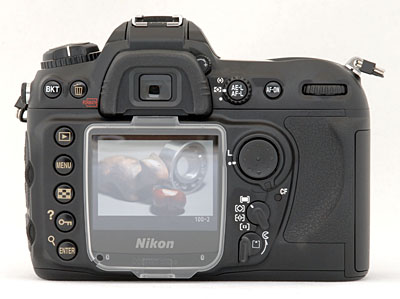
The Nikon D200's LCD is a big 2.5 inches that makes you very comfortable as well, presenting a fairly crisp image that can be magnified to what looks like greater than 100%. I've never been fond of the multi-step method necessary to zoom on a Nikon, but once you've started it goes very easily, making moving around the image pretty simple. My least favorite Nikon feature has always been the LCD cover. It's always fogging up and bulges out from the back of the camera too much. Fellow Editor Mike Pasini pointed out that though I've never scratched an LCD before, many people do so with their shirt buttons and jacket zippers. Since I don't use a neckstrap on cameras, preferring to carry them in my hand, it makes perfect sense that I'd not understand the LCD cover's function. The good news is that the cover on the D200 has been redesigned to lie flatter, and its sides are closed so it doesn't fog up as easily from your breath when holding the camera up to your eye. Because the LCD is so big, Nikon has been forced to make its profile slimmer and less noticeable, so it doesn't ugly up the back like the cover on the D70.
Doors
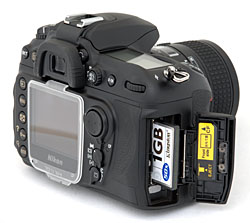
Nikon still hasn't decided what mechanism to use for their CF card doors. The D2x, D70, D50, and D200 all have different designs. Each is just fine, but I like the D200's because it is practical, seals well, and its mechanism is sure in both directions. You cradle the camera in your left hand, swing the release switch on the back of the camera, and the door swings open from the right. It opens swiftly, but with a soft sound, because there's a large rubber bumper on the inside of the hinge area to catch it. When it closes, the door mounts flush, and it cannot be opened accidentally like some other designs.
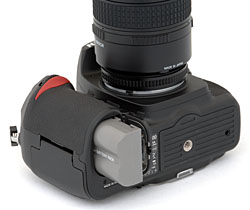
The battery door is less inspired. It should be more secure, and have a latch to hold the battery to prevent it from falling free. As it happens, however, there's a little wire running along the inside of the compartment with a bend that catches the battery after it falls out half an inch, forcing you to remove it all the way with a pull. It's arguable that this might be a faster method to change batteries, though I do wonder how well it will work after repeated use.
User Report Summary
As I said at the outset, the Nikon D200 is an absolutely exceptional camera, clearly the fourth home run in a row for the company in SLRs. It's solidly built, handles well, and has logically thought-out and arranged controls. It's a joy to shoot with, its exposure metering and 11-point AF system both performing with speed and accuracy. Tonality and color are both excellent, and the camera just seems to deliver more "keepers" per shoot than many others I've handled. The only issue that keeps me from a completely over-the-top response to it is the "Corduroy Effect" that we saw under certain very specific circumstances in response to strong light overloads. This would bother me in a camera I'd spent $1,700 for, but Dave finds it no such impediment, and in fact is almost certainly going to buy one for use both in our studio and by him personally. (While we don't yet know the outcome, Nikon is apparently investigating this issue, so what you see below will almost certainly not constitute the final word on the matter.)
Nikon D200 High Points
- 10.2-megapixel CCD delivering a maximum image resolution of 3,872 x 2,592 pixels.
- SLR design with true, TTL optical viewfinder.
- 2.5-inch TFT color LCD monitor.
- Interchangeable lens design, accommodates a wide range of "F" mount Nikkor lenses.
- Manual and automatic focus modes, with adjustable 11-point AF area selection.
- Program, Flexible Program, Shutter Priority, Aperture Priority, and Manual exposure modes.
- Shutter speeds from 1/8,000 to 30 seconds, with a Bulb setting for longer exposures.
- Depth of Field Preview mode.
- TTL exposure metering with three modes.
- Adjustable sensitivity from 100 to 1,600 ISO equivalents, plus three boost settings to a maximum of 3,200.
- User-selectable white balance with nine modes and manual fine-tuning.
- Three Color modes (actually, two in sRGB, three in Adobe RGB color space).
- Hue, Contrast, and Sharpness adjustments.
- Built-in, pop-up flash with five sync modes and exposure compensation adjustment.
- External flash hot shoe.
- PC sync terminal.
- Onboard flash works as a Commander, to control itself and up to two groups of remote slaves, using the Nikon Creative Lighting System.
- Continuous Shooting, Auto Exposure Bracketing, and Self-Timer modes.
- JPEG and RAW (NEF) file formats.
- Image storage on CompactFlash Type I or II memory cards, or Microdrive.
- USB cable for connection to a computer.
- Included CD-ROM loaded with Nikon Picture Project software.
- NTSC video cable for playback on a television set (PAL for European models).
- Power from lithium-ion battery pack, optional AC adapter, or optional Nikon Multi-Function battery pack.
- Optional remote control accessory.


No comments:
Post a Comment