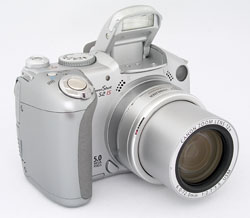
Canon PowerShot S2 IS Digital Camera
 | Camera QuickLook | |
Review Date | 06/28/05 | |
| User Level | | |
| Product Uses | | |
| Digicam Design | | |
| Picture Quality | Very Good, 5.0-megapixel CCD | |
| Print Sizes | 11 x 17 or 8 x 10 with some cropping | |
| Availability | May, 2005 | |
| Suggested Retail Price (At introduction) | $499 | |
Introduction
| ||||||||||
By Shawn Barnett
With the price of digital SLRs finally within reach, should you stick with the All-in-one digicam or move up to an SLR? Why buy a high-end digicam when digital SLRs are so close in price? Do digicams still have a purpose? What are the pros and cons? An avid photographer, I spent some time thinking about that myself. Come see what I discovered about digital SLRs versus all-in-one digicams.
The Canon PowerShot S2 IS is the sequel to an extremely popular long zoom camera, the 3.2 megapixel S1 IS. The 5.0 megapixel Canon S2 IS and its predecessor follow in the footsteps of a well-received model from four years past, the 2.6-megapixel PowerShot Pro90 IS.
The Canon S2 IS accommodates a wide range of users with its variable level of exposure control. Experienced shooters will appreciate the Manual, Aperture Priority, and Shutter Priority modes, while novices will find the Auto, Program AE, and Scene modes useful. With a full range of creative effects, the added attraction of 12x zoom Canon optics, and optical image stabilization - a feature found on only a handful of digital cameras, most of them more expensive, the Canon S2 IS will feature prominently on the shopping lists of photographers looking for a long-zoom camera. A big part of the story of the Canon S2 IS though, has to do with its movie capability: Not only can it record at 640x480 pixels and 30 frames/second, but you can use the zoom lens while recording movies (a surprising rarity), and it records stereo sound. All in all, the Canon S2 IS is quite a package, with an amazing range of capabilities and good picture quality, all at an affordable price. Read on for all the details!
The S1 IS (the Canon S2 IS's predecessor) is easily one of the most popular 3.2 megapixel cameras still on the market. Indeed, as of this writing in June 2005, the S1 IS is still number 9 in the Top Ten Sellers with our readers, among the Dave's Picks cameras. Maybe it's the camera's handsome, burly looks; or perhaps the low price for such a long, image-stabilized zoom. There's no question that the S1 IS hit a sweet spot in the market, but it had a few shortcomings.
Canon's PowerShot S2 IS overcomes most of those shortcomings and increases the camera's utility as a digital still/video hybrid. Of the two main (only?) complaints with the S1 IS, the first is not really all that valid: Folks wooed by high pixel counts were put off by the S1's 3.2 million pixels, and scads emailed to ask whether it was okay to get one anyway. I told most that it was absolutely okay, with one cautionary note -- Which brings me to the S1's second major problem: image noise at ISO 400. Our tests showed the ISO 400 results to be pretty good, even in low light; but out in the field, I personally found the color to be unacceptably blotchy at ISO 400, and recommended that people stick to ISO 200 or lower. It's not a problem unique to the S1 IS; what is unique is that both of these nice little image-stabilized cameras will get you accustomed to shooting in low light precisely because of their image stabilization, and you'll develop a tendency to push your exposure too often.
The Canon S2's 5 megapixel sensor handles both the perceived and the literal shortcoming with ease. While it still has noise at high ISO (like all point and shooters), it is far better controlled, appearing more even than that of the S1, and its higher megapixel sensor allows for plenty of cropping after capture.
Body
The Canon PowerShot S2 IS features a body design similar to that of the S1, with slightly more aggressive contours and accents throughout. It shares a familiar look and feel to the rest of the PowerShot line, along with many of the same exposure options and features. With dimensions of 4.4 x 3.1 x 3.0 inches (113 x 78 x 77.5 millimeters) and weighing some 18.55 ounces (526 grams) with batteries and SD memory card, the Canon S2 IS only a little heavier and just a smidge fatter our front due to the larger lens. This isn't a camera you'll slip into a shirt pocket, to be sure - it might fit larger coat pockets, but most likely you'll wear the camera around your neck on the included neck-strap, as I've seen so many proud S1 owners do.
We were also pleased to note that the grip on the Canon S2 IS is much better than that on the Canon Digital Rebel XT, a larger SLR camera. It's the only major criticism we had of the XT, and here the smaller, less expensive PowerShot S2 IS turns out to be a better camera ergonomically regardless of family member. It is sized just right, with your two middle fingers wrapping comfortably around the grip, the pinkie curling around underneath, and the index finger resting comfortably on the shutter. Your experience will vary, but even Dave (who was positively incensed by the XT's grip) liked the grip on the S2 IS, finding it easy to hold and balance the entire camera.
The rest of the camera body is smooth and fits the hand nicely. All controls work as expected, and the design is easy and comfortable. My only complaint is the odd power toggle/off button combination. While I understand the design, I still find myself turning it in the wrong direction. To access Record mode, whose icon is on the top left of the toggle, you have to put your thumb on the back of the toggle and move it to the right (which moves the indicator on the front of the toggle to the left). It's unnecessarily complex, and I'm not sure why they didn't just put an on/off button and a Record/Playback button to switch between the two modes.
Lens
The main reason to look at the Canon PowerShot S2 IS is the big lens. This really is the kind of lens we all want on our cameras. Just pull the zoom ring to the right, and you're able to get right up on whatever you want. Years ago, people were disappointed when they got their 200mm SLR zoom lenses because that didn't amount to such a high magnification; and they were even more disappointed when they found out how much the 300 and 400mm lenses cost. The Canon S2 IS will take you out to the equivalent of a 432mm lens, and that's not counting the digital zoom (something we don't encourage users to consider; you'll be happier cropping after the fact). Still, if you need to make your friends cry, you can tell them that your 4x digital zoom gives you the reach of a 1,728mm zoom (if not the clarity).
Image Stabilization
As if that almost ludicrous sounding focal length weren't enough, the Canon S2 IS will help you get a solid shot even at the longest zoom settings. A computer-controlled lens element inside the lens is actually moved around in time with most detected camera movement. Like most such systems, it's calibrated to adjust for twitches, breathing, heartbeat, wind; all the things we don't think about that affect our ability to hold a camera still. While we don't think about it, our cameras are honest storytellers, and will usually report these minute movements to the image sensor, which will in turn deliver blurry images to our memory cards. Even if you're a rock solid person with nerves of steel, you're going to get at least some motion blur at either the longest focal lengths or the lowest shutter speeds (like indoors in low light). Image stabilization means you'll get more clear shots more of the time.
If you shoot in Continuous mode with the Canon S2 IS, you'll be able to see the image start to float as soon as you tease the shutter button. It's the best way to shoot in low light, because it tells you how well you're holding the camera. You'll soon work with the camera better when you learn to wait for the image to stabilize. As I mentioned earlier, getting used to such a system is both good and bad, so you do have to carefully review your results. Switch to Playback mode and use the zoom lever to check for motion blur if you already know you're pushing it. If you're getting blur, you might need to raise the ISO, brace the camera against something, or flip up the flash. The IS system is excellent, and will help you get great shots you'd have never gotten otherwise, but you'll be even happier if you check how well it's doing. (Also note that the S2 IS has several different IS modes. Faced with a really challenging situation, you'll probably find that the "Shoot Only" IS mode will be more successful at compensating for extreme shake.)
Another area image stabilization comes in handy is in video capture. Usually a feature of high-end video cameras, the Canon S2 IS's always-present video mode is also enhanced by the camera's image stabilization, lending a more professional look.
AF
The S2 IS has seen an improvement in AF speed and sensitivity, due to its DIGIC II chip. This chip has been improving Canon's entire line over the last year, making all manner of functions faster and more efficient. One feature I'm missing though is the 9-point AF found on other cameras like the Canon S70, and the popular A95. In its place is the AF system borrowed from the Canon G6, called FlexiZone AF. This system allows the photographer to move the AF point all around the screen so focus can be set to wherever you deem important. In portraits, for example, you'd want to move the AF point to keep the eyes of your subject in focus. As much as I like that, in fast action settings, I've preferred the 9-point AF system, for its surprisingly accurate and speedy processing of image data. Its decisions have impressed more than they've disappointed, and I think the typical S2 IS user would be better served.
There's a manual focus mode as well, accessible by pressing the Manual Focus button on the side of the lens. I suppose it's a good feature to have, but I've never found it that useful. Even with the magnified view and distance scale, you have a heck of a time seeing any change as you adjust the focus. I find the AF system reliable enough that I've never had occasion to use manual focus. Still, it's there if you need it.
LCD
The S2 IS is really a combination of much of Canon's best PowerShot technology, and among the high points is the 1.8 inch flip out and swivel LCD. You really don't know you need this until you start to use it. Shots you'd have never considered are suddenly possible. Overhead, down low, even pictures of yourself can be framed with unprecedented accuracy and comfort. If you like to try new angles on a subject, you need a camera with a versatile LCD like this. Because LCDs generally wash out in sunlight, Canon wisely included an EVF (electronic viewfinder), to which you can switch for easier, more familiar image framing. It's a shame you can't have an optical viewfinder, but this compromise is necessary with such a long zoom.
Exposure
As seems to be the case with more and more all-purpose Canon digicams, the S2 IS has the full complement of manual and automatic exposure choices. If you just want to get the shot, you can set the camera to Auto (green zone) or P (program) and just point and shoot. But if the lighting is challenging a quick turn either left or right puts you in greater control. In Shutter, Aperture, and Manual modes, you can control how much depth of field or how much you want to freeze or blur action. But in the Scene modes, you still wield control, because you're telling the camera just what situation you're facing; and it will make the decisions from there. Settings like Portrait and Fireworks are great examples of the camera handling very unique and specific settings for you. By far, my favorite mode is Night Portrait. I've found this mode useful both in night scenes and indoor scenes, softening the impact of the flash on a subject by dialing it back, and leaving the shutter open a little longer to capture the true ambient light of the room or night backdrop. The result is a better picture that tells a truer story of the setting I saw and wanted to capture.
Long movies in stereo
The Canon PowerShot S2 IS has an unusually capable movie mode for a relatively inexpensive digicam, and its capabilities have been extended over the S1. Its movie mode allows you to capture up to 1GB of moving images and sound at either 15 or 30 frames per second, with available resolutions of 640 x 480 or 320 x 240 pixels. (Note though, that while a gigabyte of movie sounds like a lot, its only about 9 minutes worth of action at the highest quality and frame rate setting on the S2 IS.) A high-speed memory card is necessary if you want to record at the larger image size and/or higher frame rate. Its unique stereo microphones appear above the lens to the left and right, and do seem to create some separation, especially when the subjects are nearby; however, to experience the stereo, you'll need to transfer the video files to a device that can play stereo, or else play the video through a TV through the included stereo A/V cable. Several sound options allow you to change the recording bit rate and reduce wind noise on recordings. (This last is a nifty feature that's been carried over from Canon's camcorder line. - As far as I know, this is the first time that it's appeared on a digicam.)
Zoom and snap during movie recording
The Canon S2 IS's movie mode is also unusual in that it allows the zoom lens to operate while recording movies with sound. In almost all cases, digital cameras that record movies with sound disable the zoom mechanism during movie recording, as the noise of the zoom motor tends to interfere with the audio track of the movie. With the S2 IS though, Canon has chosen to allow zoom operation during movie recording, but at a reduced speed of actuation. The result is moderately successful. In quiet surroundings, you can still clearly hear the noise of the zoom motor, but it's not terribly intrusive, while in noisier environments, the noise should be entirely masked by the ambient sound. This is a useful compromise, but I do think that the manual should include a caution about zoom motor noise to make users aware of the potential impact on their sound tracks. Autofocus operation is relatively silent, thanks to the Ultrasonic focusing motor built into the S2 IS.
New to the Canon S2 is the ability to capture images during video recording. Because you activate video from the red and silver button on the camera's back, the main shutter button remains available to focus and snap a picture. And these on-the-fly still shots aren't 640 x 480 images, but full 5 megapixel images. The video stream is interrupted for a bit under a second for this capture, which creates a gap, but Canon was clever about dealing with this. In video Playback they've allowed the gap, then inserted a shutter sound and added just under a second of the still image that is captured. The resulting video looks very like the stereotypical movie scene where the private investigator is training his lens on his unsuspecting subject and snapping shot after shot. The shutter sound is inserted whether you have the sound on or not, and it cannot be disabled. I think Canon is doing that purposefully so the source of the gaps is always understood. If the AF light is turned on, you see not only the camera's focus action, but the beam itself. Personally, I'm not sure why you'd want to take a picture while doing video, but if you want to you can with the S2 IS.
Playing with the Canon S2 IS makes it clear that its designers were having a good time making not only a versatile camera, but a camera that would be fun as well. In addition to the color effects that were available on the S1, the S2 has added a Custom Color setting. You can perform all kinds of tricks with this, including intensifying or dimming specific colors, or even completely replacing one color with another. The example given in the manual shows how you can sample a color from one car and see what your own car might look like in that other color. It's really only effective if the two objects are distinct and evenly lit, but can nonetheless be fun to create surreal effects right in the camera. You can also easily darken or lighten skin tones, and emulate slide film, giving your pictures that lovely saturated "Kodachrome(tm)" look.
Memory
Add at least $70 for a nice-sized memory card to your budget before purchasing the S2 IS, because the camera only comes with a 16MB SD card. If you plan on taking advantage of the video mode, get a high speed card (Lexar 32x or above or SanDisk Ultra or Extreme) of at least 512MB, if not a full 1GB. If you have no plans to use video, then still invest in a large SD card or two. The camera captures images that are about 2MB in size apiece. You'll enjoy the camera enough that you'll fill a smaller card pretty quickly.
Battery
When I first used the camera I burned through the batteries, but it turns out I had a few sets of bum AA's. Loaded with a set of new high-quality NiMH AA rechargeables, I've been getting very good battery life, and Dave and Luke's direct tests of power drain show very good battery life indeed. The camera comes with a set of four AA alkalines, but go stick those in a flashlight and get a good set of rechargeables. Click here to read the "battery shootout" page to see which batteries currently on the market are best, or here for the review of the Maha C-204W charger, Dave's current favorite.
An AC adapter is available for the camera, which plugs into the right side of the camera, so if you're doing a lot of studio or video work, you might want to invest in one of these. A couple of sets of high-capacity rechargeable NiMH batteries and a good-quality charger really eliminate the need for the adapter in all but the most extreme cases though.
Overall, the Canon S2 IS is an impressive camera that is bound to be very popular. Its speed improvements are welcome, and its utility as a digital video/still hybrid is enhanced with the larger lens, higher resolution, and AF assist lamp. Photo enthusiasts will likely be torn between the S2 IS and the Canon G6, and family buyers will wonder whether to invest in an A95 or the S2 IS. Enthusiasts might want to augment their G6 with the S2 given its longer-ratio zoom and familiar controls, but family cam buyers looking at a 5 megapixel A-series should absolutely give the Canon S2 IS a serious look. For just a little more money and with a slightly larger body, they'll get an image stabilized 12x zoom with a virtually silent Ultrasonic focusing motor, and a camera that does double duty as a still and video camera. When it comes to viewing your images and videos at the end of the day, it's a quick upload of both types of content via the fast USB 2.0 connection from the S2 IS to the home computer, making it more likely that the content will actually be viewed in the first place. Compared to carrying separate digital still and digital video cameras, carrying the Canon S2 IS is both lighter in the bag, and easier on the pocketbook. I expect to see a lot of these little silver cameras around a lot of necks this year, this one is a real winner.


No comments:
Post a Comment